Swixx BioPharma: Journey to Ecovadis Silver
September 10, 2026


Private companies watching the UK Sustainability Reporting Standards from a distance have reasonable grounds for patience. The framework was published on 25 February 2026 on a voluntary basis (UK Government, 2026). Mandatory application for private companies requires changes to the Companies Act and a consultation process that has not yet concluded. There is no confirmed date.
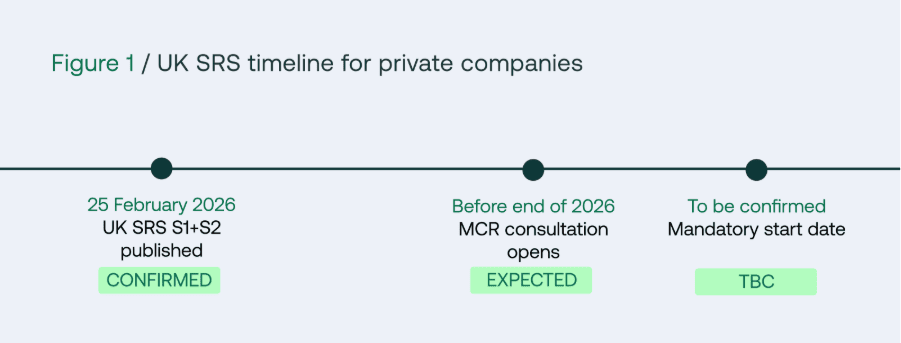
Patience, however, carries a specific risk. The triggers that matter for private companies are not waiting for the UK government’s timeline. Customers, supply chain obligations, growth trajectories, existing reporting requirements, and investors are already creating real obligations. Five considerations indicate that your organisation needs to prepare for UK SRS now.
No private company thresholds for UK SRS have been confirmed, yet the standards are final. Threshold uncertainty affects whether and when, not what.
The UK government has consistently signalled that mandatory application will follow a tiered approach aligned with existing corporate reporting size categories (UK Government, 2026). The Companies Act already differentiates between micro, small, medium, and large companies for reporting purposes.
If your company currently employs between 250 and 1,000 people, or sits between £40 million and £150 million in annual turnover, you are in the range most commonly discussed in regulatory consultations as the first wave of private company mandatory application. For a full breakdown of the UK SRS regulatory pathway for both listed and private companies, see Nexio Projects (2026b).
Sustainability reporting has an unusual property compared to most compliance work: a meaningful part of the requirement cannot be satisfied on the spot. Experience indicates it takes two- to three- reporting cycles to produce assurance-ready disclosures.
A defensible greenhouse gas inventory needs consistent organisational and operational boundaries, a documented methodology, and a prior year to compare against. Scope 3 needs supplier engagement, spend or activity data that finance systems were never designed to produce, and an honest screening exercise to work out which of the fifteen categories are material to your business. Climate resilience and scenario analysis need people inside the business to have thought about physical and transition risk in a structured way, which in most organisations is a cultural and governance exercise before it is a technical one.
If mandatory private-company reporting lands for financial years beginning in 2028 or 2029, the baseline data needed to make the first report credible has to exist from roughly FY2027, which is now.
Even if the threshold consultation lands generously and a company stays out of direct scope for years, the requirement tends to arrive anyway through commercial channels.
Listed customers preparing for FY2027 need value-chain data, and they will ask their significant suppliers for it. Lenders and insurers are already embedding climate data requests into credit and underwriting processes. Private equity owners and trade buyers ask about it in due diligence processes, and increasingly price the answer. Procurement teams at large corporates have discovered that a supplier questionnaire is a faster route to Scope 3 data than waiting for regulation to catch their supply chain.
The pattern is consistent: private companies are pulled into sustainability reporting as suppliers, borrowers and acquisition targets one to two years before they are pushed into it as filers. A structured approach, established governance and processes, and data availability will determine how well companies perform against market demands.
The strongest practical argument for starting now is that the first tranche of work does not depend on the threshold at all.
Governance and oversight arrangements. A materiality assessment that identifies which sustainability matters actually affect the business’s cash flows, access to finance and cost of capital. Organisational and operational boundaries for the GHG inventory. Scope 1 and 2 measured properly, with a documented methodology. A Scope 3 screening that establishes which categories matter and which can be justified as immaterial. Clear data ownership, so that each number has a named person and a repeatable process behind it. Basic internal controls, because assurance will eventually test them.
Every item on that list is required at any threshold. Every item is also reusable well beyond UK SRS: for SECR, for CSRD where there is EU exposure, for EcoVadis, CDP and other ESG ratings, for lender and customer questionnaires, and for the commercial conversations. If the threshold consultation ultimately leaves the company out of scope, that work is not wasted, it is reusable across other dimensions.
There is also a specific, concrete benefit available now rather than later.
UK SRS is available for voluntary use, and voluntary adoption is not effort in a vacuum. It can be used voluntarily, building on existing climate disclosures, such as TCFD.
Beyond the technical point, voluntary adoption puts you in control of effort and costs sequencing. A company preparing on its own timetable can phase the work over two or three years, use the first attempt as an internal learning exercise, discover its data gaps in a year when nobody is auditing the answer, and build capability into existing finance and operations roles rather than hiring reactively.
None of this is an argument for treating UK SRS as though the threshold were already confirmed at the most demanding level. Overpreparing can also be an expensive route to take.
The defensible position is to separate the work into what is threshold-agnostic and what is not. Start now on governance, materiality, boundaries, Scope 1, Scope 2, and Scope 3 screening, and data ownership. These are the foundations that hold at any threshold and pay for themselves through commercial and financing channels regardless. Hold as staged decisions, pending the outcome of the consultation, the things that scale with scope: full Scope 3 depth, quantified climate risk and scenario analysis, external assurance readiness, and systems investment.
Nexio Projects advises organisations on sustainability reporting, regulatory readiness and ESG strategy. If you would like to discuss what proportionate UK SRS preparation looks like for your organisation, we are happy to have that conversation.
Subscribe to our newsletter for more updates on ESRS, CSRD and reporting frameworks.