The SBTi on carbon offsets: Should they be part of your sustainability strategy?
November 19, 2024


McDonald’s announced in May 2026 that it expects to miss its SBTi-validated target to halve Scope 3 supply chain emissions by 2030. After seven years of effort, the company had reduced its Scope 3 footprint by approximately 3% against a 2018 baseline [1]. Its disclosure was unusually candid: systemic change had not moved at the pace the company anticipated when it made its commitments.
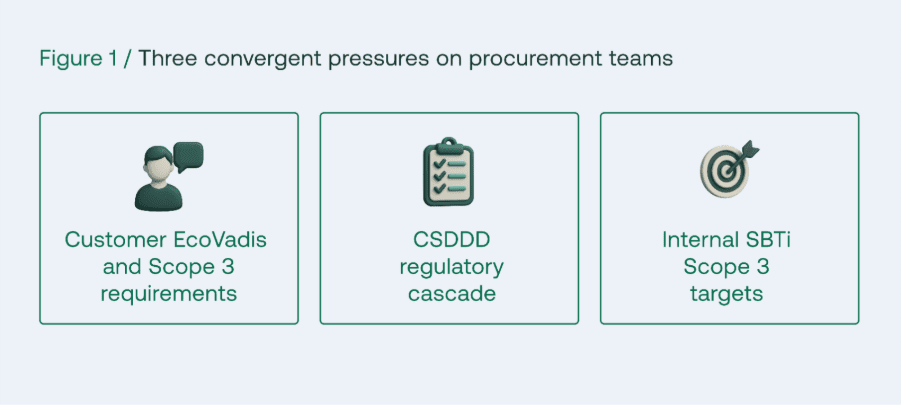
This is not a story about one company’s failure. McDonald’s disclosure is a clear account of a challenge facing companies, and particularly procurement teams, everywhere. Supply chain decarbonisation requires more than formal targets and supplier questionnaires. It requires a structured programme that builds supplier decarbonisation capability alongside supplier requirements.
Procurement managers carrying Scope 3 reduction ambitions, EcoVadis buying programme obligations, or reporting readiness requirements need a practical framework. This playbook sets one out.
“Scope 3 Category 1 sits squarely in procurement’s remit. When we run structured engagement across a supplier base, prioritising by emissions impact and building genuine supplier capability, progress follows. That is what the data from 600 projects tells us.”
For certain sectors like FMCG, Scope 3 emissions account for 75 to 95% of their total greenhouse gas footprint [2]. Category 1, covering purchased goods and services, typically represents 40 to 70% of total Scope 3 for these sectors [3].
Procurement decisions determine which suppliers are selected, on what terms, and with what sustainability requirements attached. That makes the procurement function the primary lever for Category 1 reduction. No other function holds the same degree of influence over supplier selection, contract terms, and supplier development priorities.
The regulatory environment reinforces this. The CSDDD was enacted in May 2024. It was then amended by the EU Omnibus I Directive, which entered into force on 18 March 2026. In-scope companies must now conduct due diligence on adverse human rights and environmental impacts across their value chains [4]. Member state transposition has been extended to 26 July 2028, with phased application beginning in 2029. Organisations that supply in-scope companies are already receiving due diligence requests well ahead of those dates. The commercial pressure arrives before the legal obligation.
McDonald’s is not the only company in this position. PepsiCo also adjusted its sustainability targets in 2025, citing policy headwinds and the cost of low-carbon technologies [1]. The pattern across industries is consistent: companies invest in formalising supplier sustainability requirements, issue questionnaires, and set EcoVadis score thresholds. Scope 3 emissions move slowly, or in the wrong direction.
The SBTi Supplier Engagement Guidance identifies three systemic reasons for this gap. First, supplier engagement is treated as data collection rather than capability development. Second, programmes focus on the top tier of the supply base while emissions hotspots sit further back in the chain. Third, buying organisations measure policy adoption rather than verified emissions reductions [5].
Structured engagement programmes close this gap. They combine emissions data, supplier prioritisation, capability building, and corrective action tracking into a management cycle. They treat suppliers as partners in a shared reduction journey.
Supply chain decarbonisation works as a management cycle. The following five steps reflect the approach Nexio Projects applies across manufacturing, logistics, FMCG, and chemicals engagements.
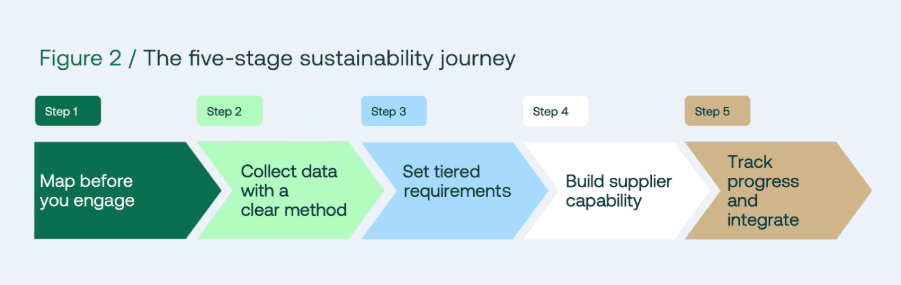
Prioritise the supplier base using spend, sector, and geography. For most organisations, 20% of suppliers account for 80% of Scope 3 emissions. Start with the highest-impact tier. Tools such as EcoVadis IQ Plus enable rapid, AI-powered inherent risk mapping across hundreds of suppliers without requiring direct supplier contact at the outset.
Spend-based methods provide a starting point for Category 1 emissions, but should be supplemented with more specific input. For example, supplier-specific Product Carbon Footprint (PCF) data, collected to ISO 14067 or aligned with the PACT Framework, provides the granularity needed to identify and verify reductions. Prioritise primary data from high-spend, high-emission suppliers first, leverage spend-based data for remaining suppliers.
A single questionnaire sent to all suppliers produces low-quality data and high friction. Segment by risk and emissions profile. High-impact suppliers require deeper engagement: carbon assessments, reduction targets, and corrective action plans. Lower-impact suppliers need a structured questionnaire and a clear improvement pathway.
The reason most supplier requirements fail to deliver reductions is capacity. Suppliers are asked to meet standards that they lack the tools and knowledge to reach. Training programmes, collaborative workshops, and access to improvement platforms change this dynamic. As the number one global EcoVadis strategic partner since 2018, Nexio Projects has built supplier capability across more than 10 sectors. 87% of clients achieved measurable score improvements, with an average uplift of 13.8 points across 600+ completed projects.
Download our supplier engagement guide to unlock each step in detail!

Sustainability performance must carry commercial weight. If award decisions are driven primarily by price, suppliers learn quickly that the programme has no consequences. Define thresholds: what triggers a conditional commercial relationship, a mandatory improvement plan, or a sourcing review. Track corrective action closure systematically.
Beyond commercial customer requirements, regulation is establishing a new baseline for supply chain due diligence. As amended by the EU Omnibus I Directive, the CSDDD requires in-scope companies to identify, prevent, mitigate, and account for adverse human rights and environmental impacts across their operations and value chains [4]. Phased application begins in 2029.
Despite the changes introduced by the Omnibus amendments, the cascade effect is unchanged. Suppliers to in-scope organisations will continue to receive due diligence requests well before 2029. Building a credible, documented supply chain sustainability programme now protects both commercial relationships and regulatory positioning.
Procurement teams should treat CSDDD readiness as a programme rather than a point-in-time compliance project. This means a responsible sourcing policy aligned to the OECD Due Diligence Guidelines, sustainability requirements embedded in RFPs and contract renewals, and a risk-based monitoring cadence updated at regular intervals.
McDonald’s experience, disclosed with unusual transparency in May 2026, confirms what procurement professionals have observed for some time. Systemic change across a supply chain takes longer, and requires more active management, than most organisations initially plan for [1].
The procurement teams making the most progress are building supplier engagement as a genuine management discipline. They combine data, capability building, commercial consequences, and continuous improvement into a repeatable programme that produces results year on year.
For teams facing customer EcoVadis requirements, CSDDD preparation, or Scope 3 targets embedded in science-based commitments, the approach is available and proven. The question is whether the programme is in place to execute it.
Ready to build a supplier engagement programme that delivers verified Scope 3 reductions?
Nexio Projects is recognised as a top sustainability consultancy by Consultancy EU and among the leading sustainability advisory firms by MT/Sprout SD400 2025. We help your decarbonisation strategy, from CFAs to PCFs and full-scale supplier engagement programmes.
Book a free discovery call with a Nexio Projects supply chain consultant to receive a tailored assessment of your current approach, your priority supplier tier, and your reporting readiness position.
Scope 3 Category 1 covers all upstream emissions from goods and services a company purchases. For manufacturing and FMCG organisations, it represents the largest share of total Scope 3 emissions, often 40 to 70% of the total footprint [3]. Procurement controls the supplier relationships and sourcing decisions that determine the size of this category, making it the primary focus for any supply chain decarbonisation strategy.
Auditing assesses a supplier’s current position. Decarbonisation requires changing it. A structured programme includes baseline measurement, supplier prioritisation, capability building, reduction targets, and progress tracking. Audits can inform the process, but they do not substitute for it. The distinction explains why companies with well-designed audit programmes still report limited progress on actual Scope 3 reductions.
A Product Carbon Footprint (PCF) measures the greenhouse gas emissions associated with the production of a specific product, typically calculated to ISO 14067 or aligned standards. Procurement teams need PCF data when enterprise customers request it as part of their own Scope 3 Category 1 measurement, or when products face emerging carbon disclosure requirements. PCF data also identifies where in the supply chain decarbonisation action will have the greatest effect.
For most organisations, 20 to 30% of suppliers account for 80% or more of Scope 3 Category 1 emissions. A focused programme covering the highest-impact tier, typically 20 to 50 suppliers in the first phase, delivers the most material reductions and provides a foundation for scaling to a broader base in subsequent years.
[1] Clancy, H. McDonald’s warns it will miss 2030 emissions goal, in frank disclosure. Trellis. https://trellis.net/article/mcdonalds-warns-it-will-miss-2030-emissions-goal/. May 2026.
[2] CDP. Corporates’ supply chain Scope 3 emissions are 26 times higher than their operational emissions. https://www.cdp.net/en/press-releases/corporates-supply-chain-scope-3-emissions-are-26-times-higher-than-their-operational-emissions.
[3] GHG Protocol. Corporate Value Chain (Scope 3) Accounting and Reporting Standard. https://ghgprotocol.org/scope-3-standard. Note: the 40–70% range for Category 1 in manufacturing and FMCG reflects Nexio Projects’ programme experience. [STAT NEEDED: search GHG Protocol Scope 3 sector benchmarks for published sector-specific Category 1 data to supplement Nexio internal figures.]
[4] DLA Piper / Weil. EU Omnibus I Directive (2026/470) entered into force 18 March 2026. https://knowledge.dlapiper.com/dlapiperknowledge/globalemploymentlatestdevelopments/2026/eu-council-approves-omnibus-i-directive.
[5] SBTi. Engaging Supply Chains on the Decarbonization Journey: Supplier Engagement Guidance. https://files.sciencebasedtargets.org/production/files/Supplier-Engagement-Guidance.pdf.