

 Environmental Product Declarations: Why your supply chain needs one in 2026
April 1, 2026


SBTi Corporate Net-Zero Standard Version 2.0 moves companies from simple target setting to demonstrating the ability to meet targets. The biggest change is the implementation of decarbonisation in operations, and a climate transition plan is the way to meet it. A transition plan needs board approval, a link to corporate strategy and a review at least every five years. It also helps companies decide on capital allocation, assets, procurement and financing.
“Don’t see transition planning only as a way to tick a box and meet a requirement from SBTi. Look at this through a strategic lens and ensure that you also get value out of this investment.”
David Vázquez, Principal Climate Consultant at Nexio Projects
That’s exactly what we discussed in the latest edition of our SBTi webinar series, your go-to resource for SBTi preparation, including the new Corporate Net-Zero Standard. In our previous session, we compared the old and new standards SBTi V1.3.1 and V2.0, whereas the next two parts dive deeper into V2 implementation.
Two changes move SBTi from commitment to delivery: climate transition plans and the updated target requirements. This article explains how climate transition plans support your SBTi targets and add value beyond them. If you want to go deeper on Scope 3 decarbonisation, sign up for our next session on supplier engagement.
SBTi published Version 2.0 of its Corporate Net-Zero Standard on 11 June 2026 [1]. The current standard, Version 1.3.1, focuses mainly on commitment: committing to reduce emissions and to meet targets. Version 2.0 puts more weight on the actions, evidence and governance needed to deliver validated targets.
New submissions made before 1 February 2027 use Version 1.3.1. From 1 February 2027 to 31 January 2028, companies can choose either version [2]. From 1 February 2028, Version 2.0 is mandatory for all new submissions.
Existing validated targets stay valid for their current cycle, subject to review and update provisions. Companies that have submitted targets under V1.3.1 might have to move to Version 2.0 when a rebaseline forces them to reset their target, or when they set new targets. That makes the transition window a planning decision as much as a date in the calendar.
Version 2.0 changes how targets are structured and puts more emphasis on implementation and evidence [1]. Even companies submitting under Version 1.3.1 will have meet these requirements when their current cycle ends and they want to set consecutive targets.
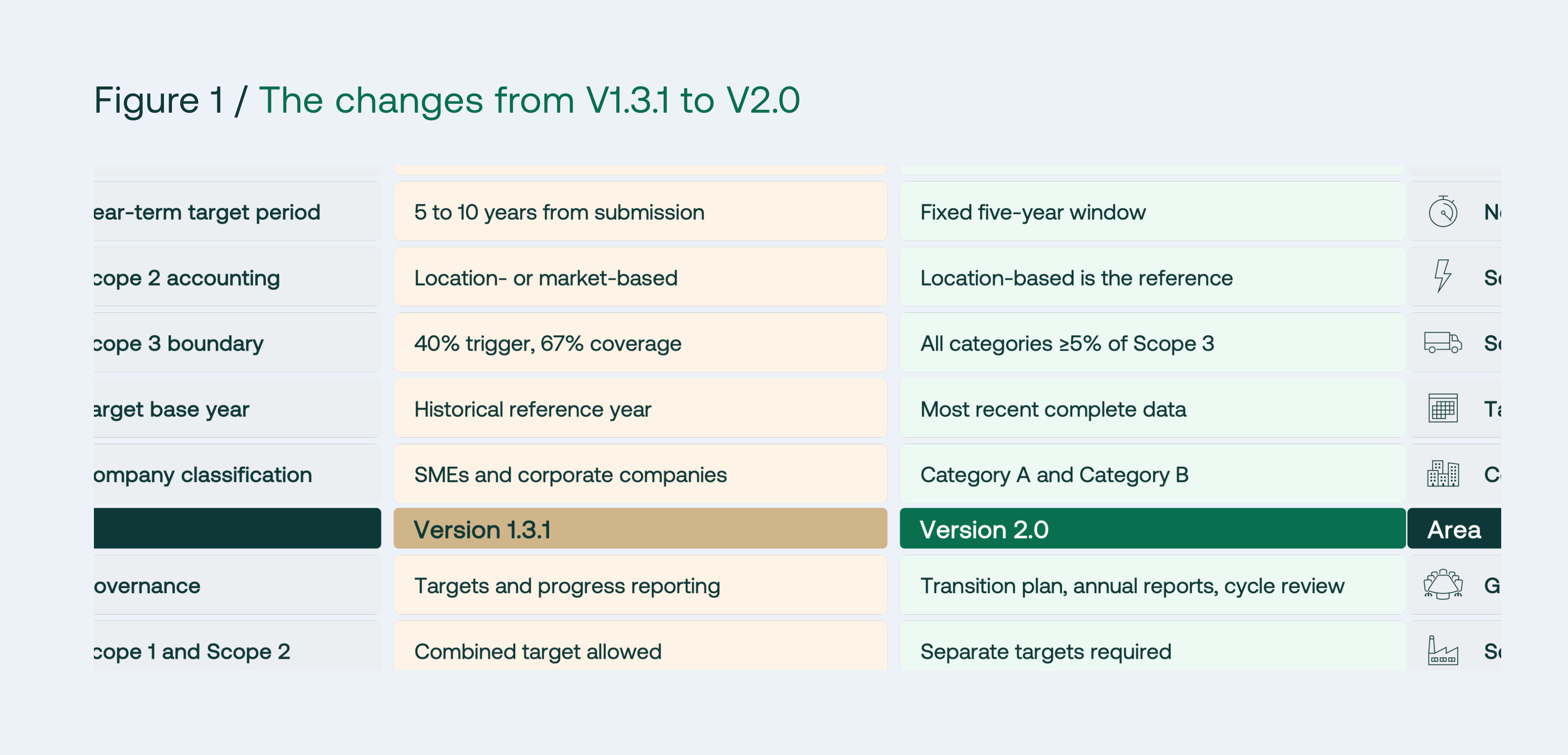
Most companies now set one combined Scope 1 and 2 target and one Scope 3 target. Version 2.0 requires three separate targets. Buying renewable electricity alone to decarbonise operations will no longer be enough, because combustion emissions under Scope 1 need their own reduction path. Location-based accounting also becomes the reference method for Scope 2.
Version 1.3.1 allows near-term targets of 5 to 10 years from submission. Version 2.0 uses a fixed five-year window, so targets always run in five-year cycles. The base year must be the most recent complete carbon footprint, not a historical reference year of your choice.
Today, a Scope 3 target is needed when Scope 3 is more than 40% of total emissions, and it must cover at least 67% of them. Under Version 2.0, every category above 5% of Scope 3 must be included. Smaller categories, that could be excluded based on the 67% threshold might now be required to be part of the project scope.
Together, these changes add an implementation layer to the standard. SBTi will ask how you will deliver your targets, monitor how you are doing and require evidence. That layer has four elements:
As Joy Stindt, Senior Climate Consultant and SBTi-certified expert at Nexio Projects, stated:
“Version 2.0 adds an implementation layer. SBTi will start asking how you will deliver your targets, it will monitor how you do that and it will require evidence.”
A transition plan brings all of these elements together. It is the document that shows how you will get from setting a target to achieving it.
The Omnibus package has narrowed how many companies fall under CSRD. Even so, climate mitigation and adaptation are coming up more often at board meetings and in corporate strategy. Climate change affects the financial side of an organisation, and pressure on climate risk keeps rising. Investors also want to know how resilient companies are to climate risk and how they plan for the transition.
Submitting targets to SBTi already costs money and effort. Treating the transition plan as a strategic tool, and not only as an SBTi requirement, helps you get more value from that investment.
A reduction roadmap starts with ambition. You set a near-term target and a net-zero target, by 2050 or earlier. You then define the actions and levers that will meet them, each with a timeline. For example, a company with a large car fleet might switch to electric vehicles or reduce the number of vehicles.
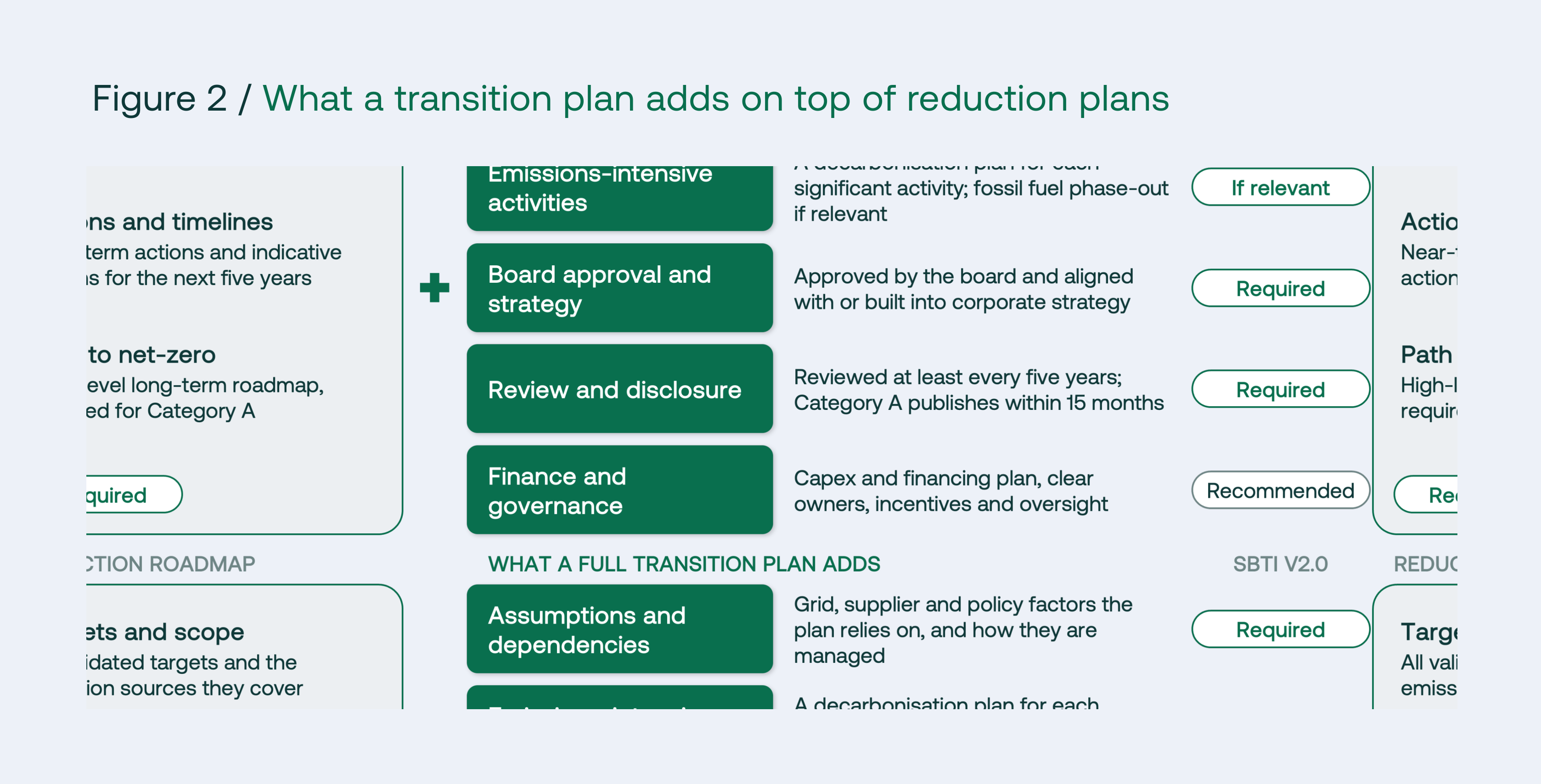
Under Version 2.0, the roadmap covers all validated targets and the emission sources they cover. It also includes near-term actions, indicative actions for the next five years and a high-level path to net zero, which Category A companies must provide [1]. A full transition plan then adds further modules:
The 15-month window means companies submitting under Version 2.0 from February 2027 do not need a finished plan straight away. They still have time to prepare it and get board approval.
The finance module deserves attention. Many decarbonisation measures can pay back. Energy efficiency investments, for example, cut Scope 1 and 2 emissions and can lower operating costs over the medium to long term.
A transition plan helps with four types of business decision. For each one, assign an owner, a timeframe, a funding route and a way to measure progress.
In practice: Ingka Group (IKEA) has invested or committed €4.3 billion in wind and solar since 2009, with a target of €7.5 billion by 2030. Emissions from its own operations have fallen 70.6% since FY16 [3]. Smaller companies can apply the same logic at their own scale. On-site solar costs money up front but cuts energy costs year after year.
In practice: HEINEKEN combines site resilience plans, heat pumps that replace gas, and power purchase agreements for its breweries. Renewable electricity rose from 84% of supply in 2024 to 88% in 2025 [4]. Gains like this get harder once a company’s share of renewable electricity is already high.
In practice: Unilever’s Supplier Climate Programme helps key suppliers set targets and share product carbon footprints. Nearly 300 suppliers took part in 2024 [5]. Supplier programmes usually start with the largest suppliers by spend, so reaching this many is significant.
In practice: Enel was one of the first issuers of sustainability-linked bonds in 2019, tying its cost of debt to climate targets. Sustainable sources provided 65% of its financing in 2025 [6].
Note: The examples above come from publicly available company disclosures. Nexio Projects has not verified the figures, and including a company does not mean it is a client.
If you submit under Version 1.3.1, you can choose a target year between 5 and 10 years from the point of submission. If we use 2026 as an example, that means 2031 to 2036, and your target is valid for that whole period. If you do not need to revalidate your targets in that time, for example because of mergers and acquisitions, your target stays valid until then. Technically, you do not need to meet the Version 2.0 requirements until then.
Yes. If you submit under Version 2.0, you need to review your base year again. Instead of the near-term target the previous standard required, the idea is to review your progress every five years. You also review the baseline you will use for each following five-year cycle.
No. In some cases you rebaseline because your emissions have changed by more than 5%, for example because of methodology changes, acquisitions or divestments. If you can still meet your target requirements afterwards, you do not need to revalidate your target.
From experience, a lot of rebaselining does lead to revalidation. For Scope 1 and 2 you do not have the flexibility of covering only 67% of your emissions: you need to cover 95%. If you rebaseline because of a 5% change and it is an increase, you will very likely need to revalidate. But there are certainly examples where you can keep the target you have in place.”
SBTi’s official recommendation is to submit your targets under the current version. During the one-year choice window, you may need to rebaseline because of structural changes or a reorganisation. In that case, it is better to align with Version 2.0 already. If you have no strategic reason to submit under Version 2.0, we suggest you use the previous standard.
That is not a requirement. What SBTi requires is an audit of your emissions. You need limited assurance of your base year and of some other metrics that are also in the transition plan. The transition plan itself does not have to be externally audited. It does need board approval, which is one of the main requirements. It needs internal buy-in and must be aligned with your corporate strategy, but no external audit is required at this point.
Version 2.0 judges a target by the evidence that you can deliver it. Most companies will submit under Version 1.3.1 in 2027, but a re-baseline, a reorganisation or the end of a target cycle will eventually bring them under Version 2.0. Building the transition plan early gives your board time to approve it. It also turns an SBTi requirement into a tool for capex, procurement and financing decisions.
As David Vázquez stated:
“Sometimes when we develop a plan to decarbonise, we think it is an investment with no return. But in most cases, you will be able to reduce your OpEx in the medium to long term.”
We are an international sustainability consultancy that helps organisations move from compliance to positive impact, with expertise in carbon footprinting, SBTi target setting and climate transition planning.
Recognised among Europe’s top sustainability consultancies by Consultancy EU and as a Top Brand in sustainability by EUPD, we help you build a transition plan that delivers your targets and strengthens your business.
Book a free consultation with our climate team to map your path to SBTi Version 2.0.
[1] Science Based Targets initiative. Corporate Net-Zero Standard Version 2.0 (June 2026). https://files.sciencebasedtargets.org/production/files/Corporate-Net-Zero-Standard-version-2.pdf. Accessed November 2026.
[2] Science Based Targets initiative. The Corporate Net-Zero Standard. https://sciencebasedtargets.org/corporate-net-zero. Accessed November 2026.
[3] Ingka Group. Annual Summary and Sustainability Report FY25. https://assets.site.ingka.com/ingka-com/reports/IngkaGroup_AnnualSummaryandSustainabilityReport_FY25.pdf. Accessed November 2026.
[4] Heineken Holding N.V. Annual Report 2025. https://www.heinekenholding.com/sites/heinekenholding-v2/files/2026-03/heineken-holding-nv-annual-report-2025.pdf. Accessed November 2026.
[5] Unilever. Climate action. https://www.unileverusa.com/sustainability/climate/. Accessed November 2026.
[6] Enel S.p.A. Integrated Annual Report 2025 (via MarketScreener). https://www.marketscreener.com/news/enel-s-p-a-integrated-annual-report-2025-ce7e50dedd88f422. Accessed November 2026.


