

 Best CSRD consultants in Europe: Choose your best fit
April 23, 2026


Most private equity (PE) firms now have environmental, social and governance (ESG) investment and portfolio management processes in place. Fund-level sustainability frameworks are documented. Limited partner (LP) commitments have been made. ESG sits on every general partner’s (GP) operating dashboard.
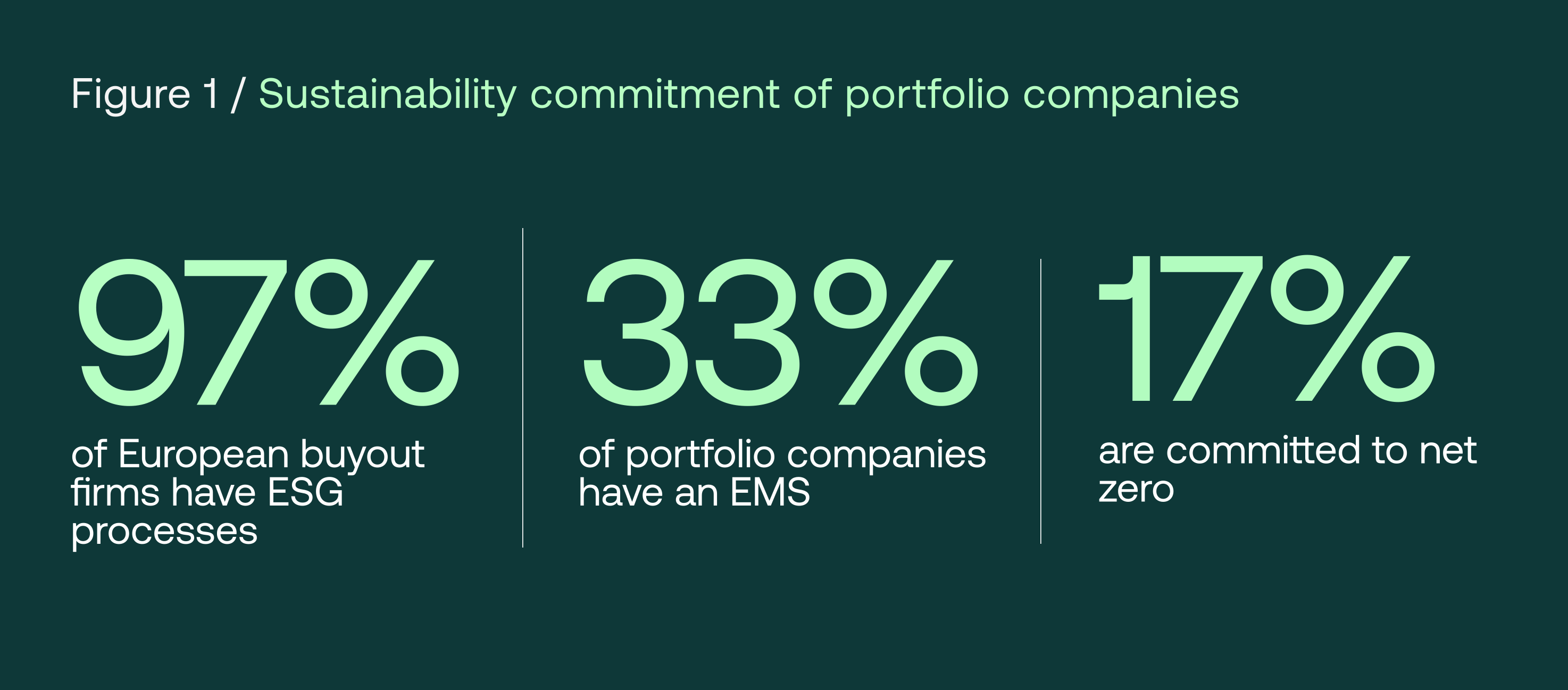
Only 33% of portfolio companies have an environmental management system. Only 17% have committed to net zero. The execution gap between GP ambition and portfolio company delivery is structural, measurable, and widening with every reporting cycle [3]. The sustainability question in private equity in 2026 is not whether to act. It is how to close that gap efficiently, to an auditable standard, before the next LP reporting cycle, the next customer contract renewal, or the next deal.
This is not a problem that operates at single-asset level.

A multi-PE-backed industrial group with four subsidiary platforms, more than 50 manufacturing plants, more than 7,000 employees across Europe and the US, had previously managed sustainability separately at each platform: different methodologies, different consultants, no shared governance model. The consequence: GP-level consolidation of LP data was a three-week exercise at every reporting cycle, with no comparable outputs across assets. A coordinated programme with a consistent double materiality assessment (DMA) approach, shared evidence templates, and a group-level ESG framework resolved the structural duplication and gave the PE owners one auditable view across the full portfolio.
Three structural forces have converged to put sustainability strategy at the centre of how PE-backed companies are managed and valued. Regulatory requirements, LP mandates, and a growing body of financial evidence have removed the remaining case for deferral. Nexio Projects works with more than 40 portfolio companies across relationships with 17 PE firms. The same pattern appears across every engagement: demand for structured sustainability output: EcoVadis ratings, greenhouse gas (GHG) inventories, CSRD double materiality assessments, CDP submissions is rising faster than the internal capacity of portfolio companies to deliver it.
The ESG Data Convergence Initiative (EDCI) now counts more than 500 GP and LP members representing approximately $59 trillion in assets under management (AUM), tracking standardised sustainability metrics across more than 9,000 portfolio companies [4]. Major institutional capital allocators such as pension funds, sovereign wealth funds, endowments are embedding ESG data requirements as conditions of continued commitment. A policy document does not satisfy. The data they require is auditable, company-level, and annual.
The Principles for Responsible Investment (PRI) 2025 reporting cycle saw a record 4,000-plus signatories participate. Of those, 81% identified specific sustainability outcomes, and 70% are actively implementing stewardship or investment strategies to deliver on them [5].
The consequence lands at portfolio company level. Invest Europe’s ESG KPI Report 2025, which covered 1,167 European PE and venture capital firms across 6,902 portfolio companies, found that 90% of PE firms have ESG investment processes in place — rising to 97% among buyout firms [3]. Yet only 33% of portfolio companies had an environmental management system. Only 17% had committed to net zero [3].
That gap is where LP pressure arrives as operational workload — on management teams that were not built to absorb it.

A US buyout fund’s portfolio company — a global healthcare packaging manufacturer with more than 1,000 employees across four countries — had a starting EcoVadis score of 51, below the Bronze threshold a key pharmaceutical customer had set as a contract condition. Three structured annual improvement cycles moved the score from 51 to 68: Bronze achieved, plus 17 points, with the pharma contract renewed at each cycle. In parallel, the company completed its first full Scope 3 GHG inventory across European and US operations — used directly in the PE owner’s LP ESG reporting. An SBTi gap analysis confirmed the near-term target pathway. The 2026 cycle is already underway, and it is materially faster than the first, because the evidence library is in place.
The EU’s regulatory architecture creates layered obligations that operate simultaneously at fund level and portfolio company level.
For funds managing Sustainable Finance Disclosure Regulation (SFDR) Article 8 and Article 9 classifications, portfolio companies must measure and report GHG intensity, biodiversity exposure, water emissions, and social data against principal adverse impact (PAI) indicators. The GP cannot generate this data centrally; it must come from portfolio companies. A fund with twelve assets and a Q1 LP reporting deadline has twelve parallel data collection workstreams in motion at the same time — unless a portfolio-wide programme standardises them.

The Scope 3 obligation is not a marginal one. For one PE-backed consumer goods company, Scope 3 accounted for 99% of the total carbon footprint, with purchased raw materials driving over 85% of the figure. That concentration is invisible without a full inventory — and it is precisely the data SFDR PAI disclosure now requires GPs to collect and report at portfolio level.
On sustainability reporting, the Corporate Sustainability Reporting Directive (CSRD) remains one of the most consequential obligations for mid-market PE-backed businesses with European operations. The EU Omnibus Simplification Package, as currently proposed and subject to finalisation by the EU co-legislators [6], has raised the formal CSRD scope threshold to companies with more than 1,000 employees. But the trickle-down effect closes the compliance gap quickly. A PE-backed manufacturer supplying a CSRD-compliant customer must provide Scope 3 data and supply chain due diligence information as a condition of that customer relationship, regardless of whether the manufacturer is directly in CSRD scope.
The Corporate Sustainability Due Diligence Directive (CSDDD), which entered into force in July 2024 with civil liability phasing in from 2027, adds a second cascade. CSDDD-scope customers will require cooperation from significant suppliers on human rights and environmental risk management. The obligation flows down the supply chain independent of the supplier’s own regulatory status.
The EU’s Carbon Border Adjustment Mechanism (CBAM) entered its definitive application phase on 1 January 2026 [7]. CBAM now imposes a direct carbon cost on imports of steel, aluminium, cement, fertilisers, electricity, and hydrogen. For PE portfolios with assets in these sectors, that is a balance-sheet line and not a future consideration.

A PE-backed pharmaceutical contract development and manufacturing organisation (CDMO), 6,900 employees, 15 facilities across seven countries, faced three simultaneous requests from two PE sponsors in the same year: submit CDP Climate Change, achieve EcoVadis Silver, and deploy a sustainability management system (SMS) across all sites. The company had never submitted CDP. The starting EcoVadis score was 58. No formal SMS existed. Nexio Projects designed one integrated programme across all three workstreams, with shared evidence collection and governance documentation. Within 12 months: EcoVadis moved from 58 to 70 (Silver achieved), the company’s first CDP Climate Change disclosure was submitted, and the SMS was operational across all 15 facilities. Both PE sponsors received the SFDR climate data they needed on schedule. The annual cycle is now structurally faster than the first, because the evidence library and SMS are already in place.
“A premium at entry, a deal-stopper risk at exit, and a measurable EBITDA effect through hold. These numbers now belong in the investment committee memo, alongside IRR and leverage.”
BCG’s third annual analysis of sustainability in private markets, produced with the EDCI and drawing on data from more than 9,000 portfolio companies and 320 GPs, found that PE firms estimate sustainability efforts improve realised EBITDA by 4% to 7% over the hold period [2]. The proportion of portfolio companies with active decarbonisation strategies and short-term emissions reduction targets each increased by 7 to 9 percentage points year on year — significantly outpacing the 1 percentage point improvement in long-term net zero commitments Companies held for more than four years use materially more renewable energy than newly acquired assets, demonstrating that hold-period length is itself a sustainability advantage when the foundations are built early [2].
Research from BCI (managing CAD 295 billion in assets) and Stanford University’s Long-Term Investing Initiative, published in January 2026, found that ESG integration across BCI’s $25 billion PE portfolio produces meaningful double-digit percentage increases in projected enterprise value. One targeted operational change at a single logistics holding, restructuring driver compensation practices, generated $18 million in avoided annual expenses, projecting a $144 million enterprise value uplift from a single focused intervention [1].
At deal level, KPMG’s Global ESG Due Diligence Study 2024, drawing on 600-plus active dealmakers across 35 geographies, found that 45% of investors encountered significant deal implications from material ESG findings in due diligence and for more than half of those, it was a deal-stopper [8]. At the same time, 55% were willing to pay a premium of between 1% and 10% for assets with high ESG maturity [8].
A premium at entry. A deal-stopper risk at exit. These are transaction-level financial variables, not sustainability team KPIs.
The requirements above all arrive as time-bound operational deliverables for management teams that were not hired to run sustainability programmes.
A mid-market PE-backed company in 2026 may face, within a single financial year: an EcoVadis assessment for a key customer contract renewal; a full GHG inventory including Scope 3 for fund-level LP reporting; a double materiality assessment (DMA) as part of CSRD readiness; a CDP Climate Change submission for the GP’s SFDR obligations; and the first steps toward science-based targets (SBTi). Each workstream requires specific methodological expertise. EcoVadis rewards a precise evidence architecture. CDP follows a distinct disclosure methodology. A DMA requires documented stakeholder engagement and formal materiality ranking. None of these can be reliably delivered by a part-time sustainability resource without specialist support.

A pan-European PE firm required its portfolio company with 6,000 employees, operations across more than 30 countries, to sustain EcoVadis Gold while simultaneously delivering a CSRD-ready DMA. Both workstreams ran through one integrated programme. Four consecutive EcoVadis re-assessment cycles held the score between 76 and 78: Gold sustained in every cycle, including through EcoVadis’s shift to a percentile-based ranking methodology. The DMA was completed to audit-ready standard for limited assurance review. The company’s first Scope 3 GHG inventory was completed across all countries of operation, giving the PE owner its first LP-ready carbon baseline for SFDR reporting and target-setting. Each cycle is faster than the last. The evidence library is already in place.
The window is shorter than most management teams realise. Moving an EcoVadis score from 51 to Bronze takes a structured multi-cycle programme, not a last-minute evidence sprint. A CSRD-ready DMA cannot be produced in three weeks. PE firms that build sustainability infrastructure in year one of ownership have time to compound. Those that begin in year three or four are building a retrospective narrative under a tight timeline.
“Funds that build sustainability infrastructure in year one compound the advantage through hold. By exit, the asset tells a coherent, auditable story. That is not something you can reconstruct in year three.”
If your PE portfolio has sustainability obligations arriving faster than internal capacity, Nexio Projects can help build a programme that compounds year on year rather than restarts each cycle. A focused discovery conversation, no pitch deck required.
[1] FTI Consulting. ESG and Sustainability Trends for Private Capital in 2026. https://www.fticonsulting.com/insights/articles/esg-sustainability-trends-private-capital-2026. Published February 2026. Accessed March 2026. (Includes reference to: Greenfield, Monk, Rook. “ESG Value Creation in Private Equity: From Rhetoric to Returns.” BCI / Stanford, January 2026. https://papers.ssrn.com/sol3/papers.cfm?abstract_id=6000614.)
[2] BCG / ESG Data Convergence Initiative. Sustainability in Private Markets, 2025: How Staying the Course Creates Value. https://www.bcg.com/publications/2025/the-value-of-staying-sustainable-in-private-markets. Published October 2025. Accessed March 2026.
[3] Invest Europe. ESG KPI Report 2025: Managing What You Measure. https://www.investeurope.eu/esg-kpi-report-2025/. Published 2025. Accessed March 2026. (Data covers 1,167 PE/VC firms, 6,902 portfolio companies. ESG KPI data relates to the 2023 performance year.)
[4] ESG Data Convergence Initiative. About the EDCI. https://www.esgdc.org/. Accessed March 2026.
[5] PRI. What Does 2025 PRI Reporting Data Tell Us About Signatory Policies, Commitments and Strategy? https://public.unpri.org/pri-blog/what-does-2025-pri-reporting-data-tell-us-about-signatory-policies-commitments-and-strategy/13580.article. Published 2025. Accessed March 2026.
[6] European Commission. Omnibus Simplification Package — Proposed Amendments to CSRD. February 2025. As currently proposed, subject to finalisation by the EU co-legislators. https://commission.europa.eu/publications/omnibus-simplification-package_en. Accessed March 2026.
[7] European Commission. Carbon Border Adjustment Mechanism (CBAM). Regulation (EU) 2023/956. Definitive phase from 1 January 2026. https://taxation-customs.ec.europa.eu/carbon-border-adjustment-mechanism_en. Accessed March 2026.
[8] KPMG International. Global ESG Due Diligence Study 2024. https://kpmg.com/xx/en/our-insights/esg/global-esg-due-diligence-study-2024.html. Published 2024. Accessed March 2026.


