 All you need to know before hiring a sustainability manager
March 18, 2024


A growing share of the chemicals industry’s climate impact lies in value‑chain activities that are not directly controlled, but are still strongly influenced, by manufacturers. This article explains how those Scope 3 emissions break down across key categories, and why focusing on upstream activities is critical for Achieving Net Zero in chemicals.
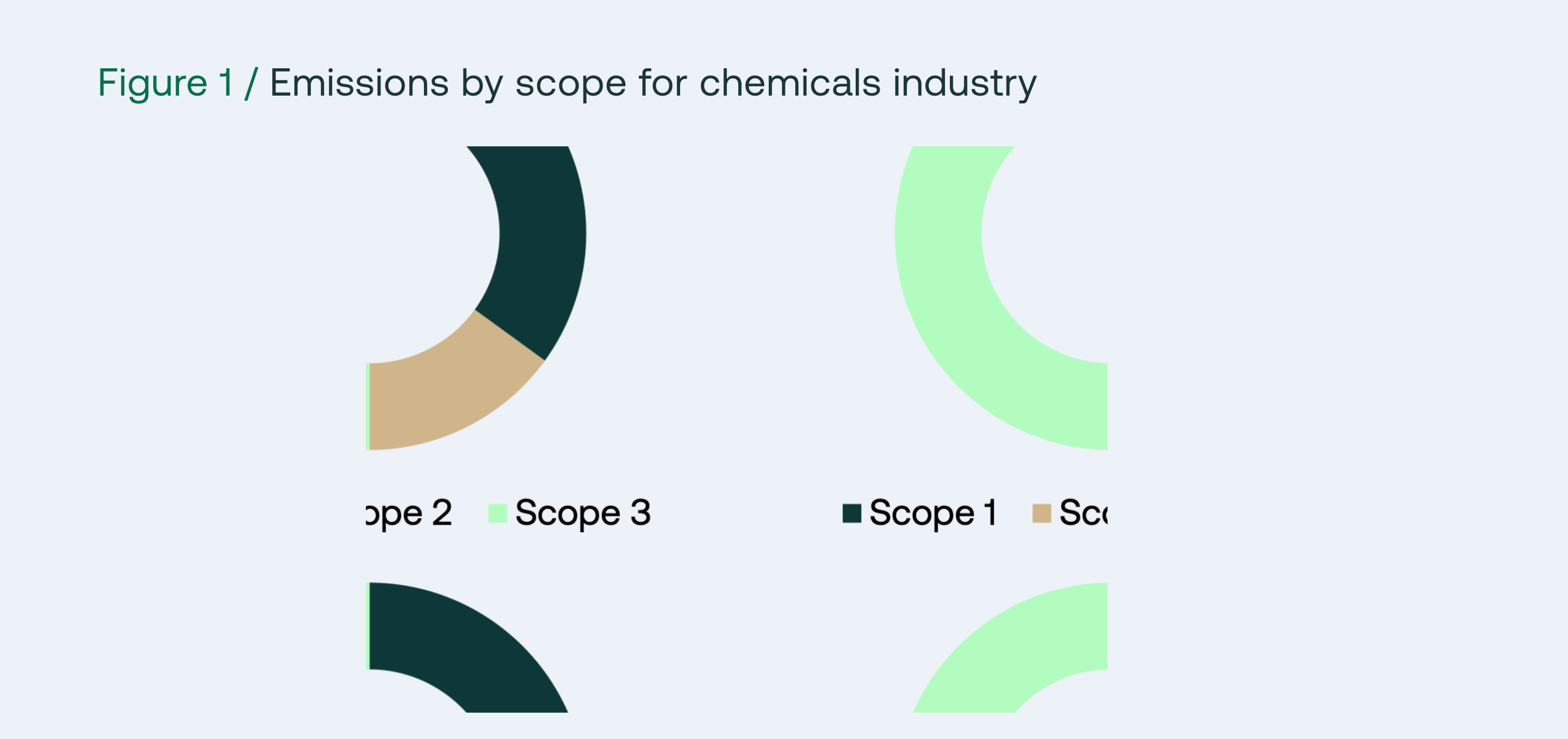
For a typical chemical company, Scope 3 emissions account for the majority of total GHG emissions, while Scope 1 emissions from on‑site combustion and process activities and Scope 2 emissions from purchased electricity represent smaller portions of the footprint. This distribution underlines that indirect value‑chain emissions usually outweigh direct and energy‑related emissions, so any credible decarbonisation strategy must prioritise carbon emissions scope 3 alongside operational improvements.
Within Scope 3, Category 1: Purchased Goods and Services and Category 12: End‑of‑Life Treatment of Sold Products typically dominate in the chemicals industry, together accounting for the vast majority of value‑chain emissions in the example shown. Category 1 reflects the high carbon intensity of purchased feedstocks, solvents and intermediate chemicals, while Category 12 captures downstream treatment such as incineration or landfill, with Categories 4 and 10 contributing smaller but still relevant shares linked to logistics and processing of sold products.
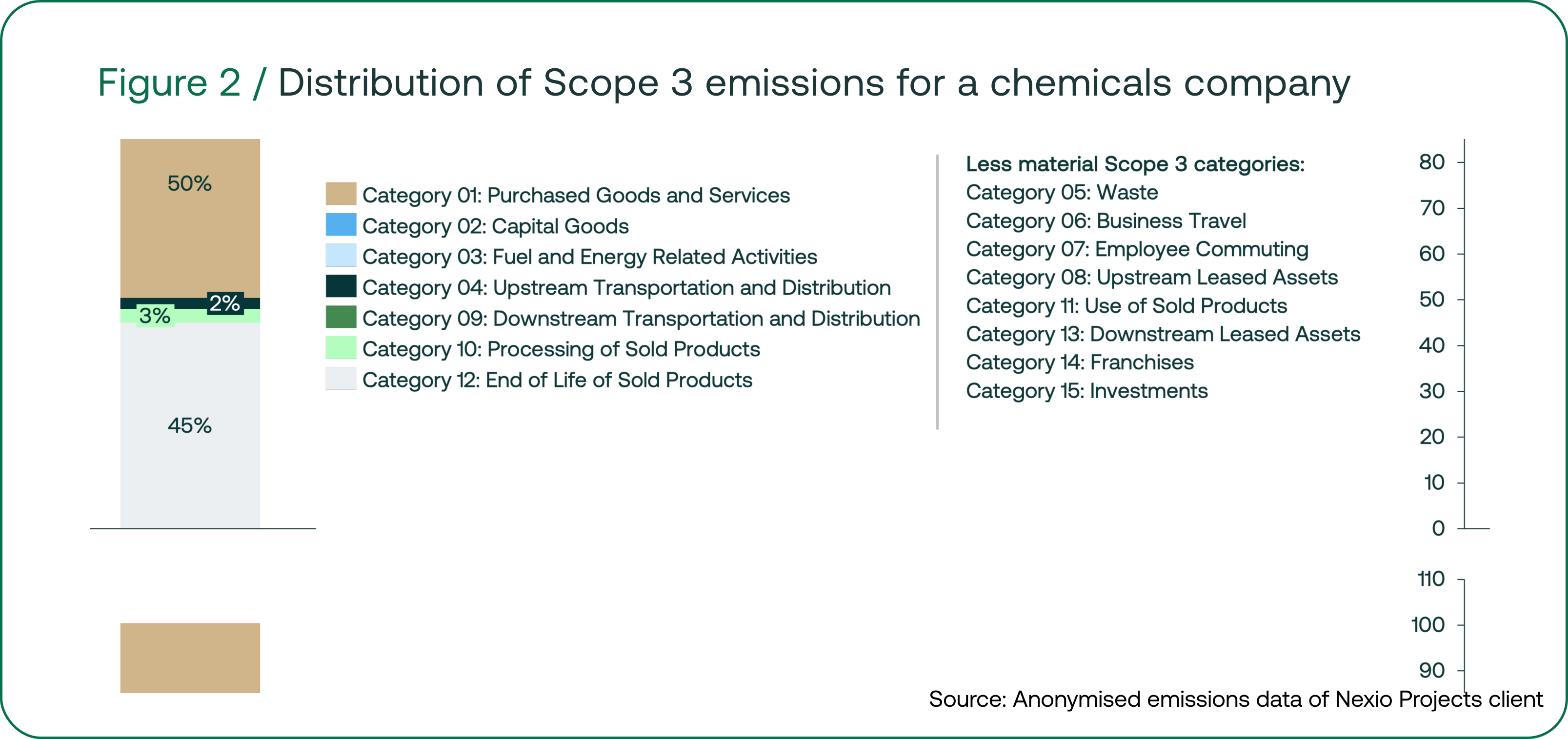
Upstream emissions in the chemicals sector cover all Scope 3 categories linked to purchased goods and services, capital equipment, fuel and energy‑related activities, transportation and distribution, waste, business travel, employee commuting and upstream leased assets. These categories are particularly important because they can be shaped through procurement standards, supplier selection, contract structures and data‑driven collaboration, forming a core pillar of any decarbonisation action plan.
In practice, upstream Categories 1–4 are usually the most material for chemical manufacturers, with Category 1 often dominating total Scope 3 emissions and Categories 2, 3 and 4 adding additional but smaller shares. The remaining upstream categories (5–8) tend to be lower but are essential for a complete Scope 3 emissions inventory and for demonstrating robust management of overall GHG emissions.
In the chemicals industry, nearly half of total Scope 3 emissions can arise from Category 1: Purchased Goods and Services, reflecting the high carbon intensity of raw material inputs such as feedstocks, solvents and other intermediate chemicals. These upstream materials often involve energy‑intensive production processes, which significantly drive a company’s indirect footprint and therefore sit at the centre of any Decarbonisation Action Plan.
Category 2: Capital Goods covers long‑lived assets such as buildings, production facilities, heavy machinery, IT infrastructure and company vehicles that are treated as fixed assets with depreciating value in financial accounting. The GHG Protocol requires reporting all upstream cradle‑to‑gate emissions associated with these assets in full during the year of purchase rather than spreading them over the useful life, aligning financial and carbon boundaries and preventing under‑reporting.
Distinguishing capital goods from purchased goods and services is essential to avoid double counting. Ensuring that each purchase is allocated to only one category according to internal capitalisation rules. Emissions from transportation of purchased goods or capital assets in vehicles not owned or controlled by the company should be reported in Category 4 rather than within Categories 1 or 2, as misallocating these emissions is a frequent reporting error in Scope 3 emissions accounting.
Consider a chemical manufacturer purchasing 500 kg of industrial solvent as a routine consumable for plant operations—this is treated as an operating expense under Category 1: Purchased Goods and Services rather than as a capital good, because it is not a long‑term fixed asset.
To estimate emissions using an activity‑based method, multiply the quantity purchased by an industry‑average emission factor: 500 kg×2.5 kg CO₂e/kg=1,250 kg CO₂e500 kg×2.5 kg CO₂e/kg=1,250 kg CO₂e. Alternatively, a spend‑based method uses the total cost and a financial emission factor, for example 2,500×1.20 kg CO₂e/£=3,000 kg CO₂e2,500×1.20 kg CO₂e/£=3,000 kg CO₂e, highlighting how method choice can change reported emissions and why supplier‑specific Product Carbon Footprints are preferable when available.
Scope 3 Category 3 covers upstream emissions from the extraction, production and transportation of fuels and utilities purchased and consumed by the company, including electricity, steam, heating and cooling. For chemical sites, this category separates supply‑chain impacts from direct combustion reported in Scope 1 emissions and generation‑related impacts captured in Scope 2 emissions.
Category 3 emissions are calculated using the same activity data as Scope 1 and 2 (such as litres of fuel consumed or kilowatt-hours of electricity used), but with different emission factors that capture upstream emissions rather than direct combustion or purchased energy use. In practice, companies typically apply an average-data method using regional emission factors per unit of consumption.
For electricity, steam, heating and cooling, these factors should cover fuel extraction, production and transportation, as well as transmission and distribution losses. Where available, supplier-specific emission factors from fuel and utility providers may be used to increase accuracy.
Category 4 includes emissions from transportation and distribution services paid for by the reporting company, such as inbound logistics from suppliers, inter‑facility transfers and storage in third‑party warehouses or vehicles that are not owned or controlled by the company. Transport modes can include road, rail, sea and air freight, while distribution generally covers storage in warehouses, terminals and other facilities handling bulk and packaged chemicals.
A common misconception is that all outbound transportation from a company’s facility to the customer is considered downstream, whereas in fact any transport service paid for by the reporting company remains upstream Category 4 because it is a purchased service. If the customer arranges and pays for the transport, those emissions are classified as downstream transportation and distribution under Scope 3 Category 9, so clear contractual arrangements are crucial for allocating Scope 3 emissions correctly.
Imagine the same company contracting a logistics provider to ship bulk chemicals by road and sea; because the transport service is purchased, the associated emissions fall under Category 4: Upstream Transportation and Distribution.
If 4,000 tonnes are shipped by road over 2,000 km and 2,500 tonnes are shipped by sea over 12,000 nautical miles, a distance‑based approach multiplies tonnes, distance and an emission factor for each mode, then sums the results, giving a clear, step‑by‑step estimate of Scope 3 emissions that can be tracked and reduced over time.
Category 5 covers emissions related to third‑party disposal and treatment of waste generated from the reporting company’s operations, recorded in the year the waste is generated even if treatment and associated emissions occur later. In the chemicals industry, this can include production scrap, packaging waste, hazardous residues, wastewater and sludge, each with different treatment routes such as landfill, incineration, recycling, composting, waste‑to‑energy or wastewater processing.
Waste‑type‑specific methods use detailed data and treatment‑specific emission factors, while average‑data methods aggregate emissions based on total waste quantities and typical treatment mixes where granular data are not available. Selecting appropriate methods and improving data quality for major waste streams helps companies manage environmental risk and maintain a robust Scope 3 emissions inventory.
Some common chemical waste types include:
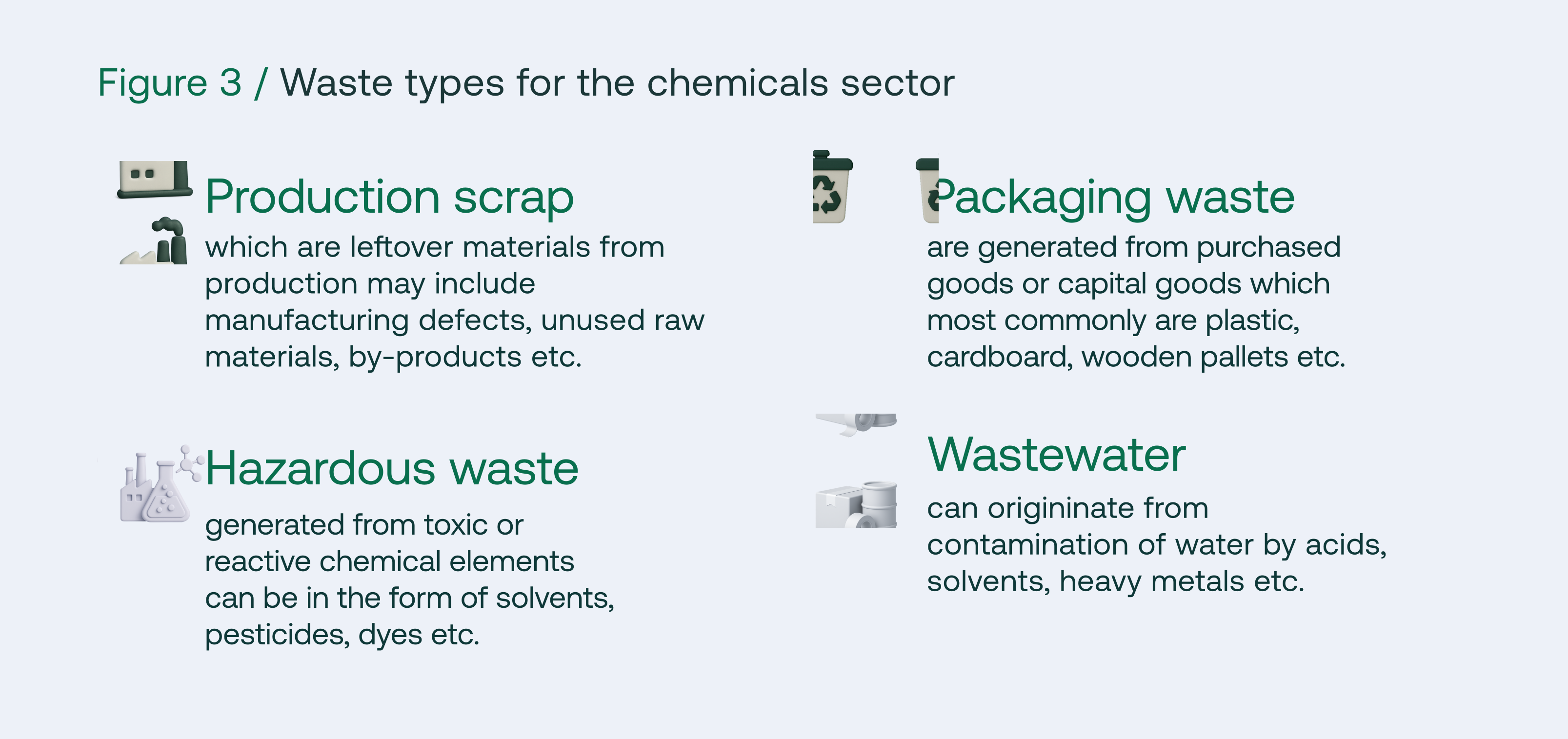
These waste types can often use waste‑specific emission factors for particular treatment routes, while remaining mixed waste can be handled using average‑data factors to balance practicality and accuracy in reporting GHG emissions.
Category 6: Business Travel includes emissions from employee business transportation in non‑company vehicles, such as flights, trains, taxis and reimbursed personal cars, and may optionally cover accommodation. Fuel‑ or distance‑based methods using travel and expense records usually provide more reliable estimates than spend‑based approaches and can be integrated into wider policies for Reducing Scope 3 Emissions from mobility.
Category 7: Employee Commuting covers emissions from employees travelling between home and work, and is generally estimated using employee surveys capturing commuting distances, modes of transport and working patterns. Distance‑ or average‑data methods based on survey results and national emission factors can then be used to extrapolate total commuting emissions across the workforce.
Category 8 captures emissions from leased assets not owned or financially controlled by the company, such as rented machinery, warehouses or vehicles under operating leases, where emissions may need to be reported under Scope 3 depending on the organisational boundary. Asset‑specific, lessor‑specific or average‑data methods can be applied using energy and fuel data, ensuring that Scope 1 emissions, Scope 2 emissions and Scope 3 emissions are assigned consistently without double counting.
Imagine Company A leasing a refrigerated vehicle for transporting chemicals under an operational lease, while using financial control to define its organisational boundary; in this case, emissions from the leased asset fall under Category 8: Upstream Leased Assets.
Using an asset‑specific method, the company multiplies annual diesel use and refrigerant top‑up by their respective emission factors—for example, diesel litres by a fuel factor and kilograms of HFC‑134a by a global warming potential factor—and then adds the two results, giving a straightforward total that reflects the full climate impact of the leased truck’s operation.
Accurate and transparent value‑chain emissions accounting is essential for credible corporate sustainability reporting and effective climate risk management in the chemicals sector. Applying the GHG Protocol principles of relevance, completeness, consistency, transparency and accuracy, and prioritising robust data collection, standardised methodologies and supplier engagement, enables companies to build inventories that support informed decisions and targeted action on Scope 3 emissions.
By focusing on upstream hot spots such as purchased raw materials, energy and logistics, chemical companies can identify interventions—from low‑carbon feedstocks and renewable energy procurement to logistics optimisation and waste reduction—that deliver meaningful progress towards achieving net zero.

Nexio Projects is a pure‑play sustainability and climate consultancy, recognised as one of the top ESG consultancies by Consultancy.nl and Verdantix. We support more than 100 clients in building full GHG inventories and mapping their decarbonisation journey across Scope 1 emissions, Scope 2 emissions and Scope 3 emissions.
A team of highly skilled climate experts brings in‑depth knowledge of company processes and data architecture to design and implement tailored Decarbonisation Strategies. With experience across more than 20 sectors—and chemicals as one of the main areas of expertise, Nexio Projects helps organisations move from measurement to implementation, turning complex emissions data into a practical actions that accelerate reducing scope 3 emissions across the value chain.
If you’re interested in further specialisation, contact us for a free consultation call!
Subscribe to our newsletter for monthly ESG updates, sector trends and actionable tips!