How to become a B Corp: A closer look at the B Impact Assessment
February 28, 2025


“The Environment theme rewards a management system that can be evidenced clearly.”
Many companies approach the EcoVadis Environment theme as a document collection exercise. They search for policies, reports, certificates, and spreadsheets before checking whether each document supports a specific answer.
That approach creates unnecessary volume. It can also leave important gaps between commitments, actions, and results.
EcoVadis describes its methodology as an assessment of a company’s sustainability management system through policies, actions, and results.[1] Supporting documents help analysts verify those elements. EcoVadis states that answers can be submitted without documentation, but unsupported answers cannot receive credit.[2]
This distinction explains a common concern: a company may have strong environmental practices but still struggle to evidence them clearly.
The better starting point is a simple evidence map:
Companies can use EcoVadis’ explanation of supporting documents to test whether their evidence is recent, relevant, complete, and linked to the assessment scope.[2]
A strong document does more than mention sustainability. It shows ownership, scope, implementation, review, and progress.
For example, an environmental policy becomes more useful when it identifies the organisation, applies to the relevant activities, includes a review date, and connects to practical responsibilities. An emissions report becomes more useful when it explains the reporting boundary, period, methodology, and performance trend.
EcoVadis currently allows companies to optimise submissions within a 55-document limit.[3] That limit makes prioritisation essential. Combining unrelated files can reduce clarity, while uploading several versions of the same policy can consume space without adding evidence.
The recurring questions are therefore practical:
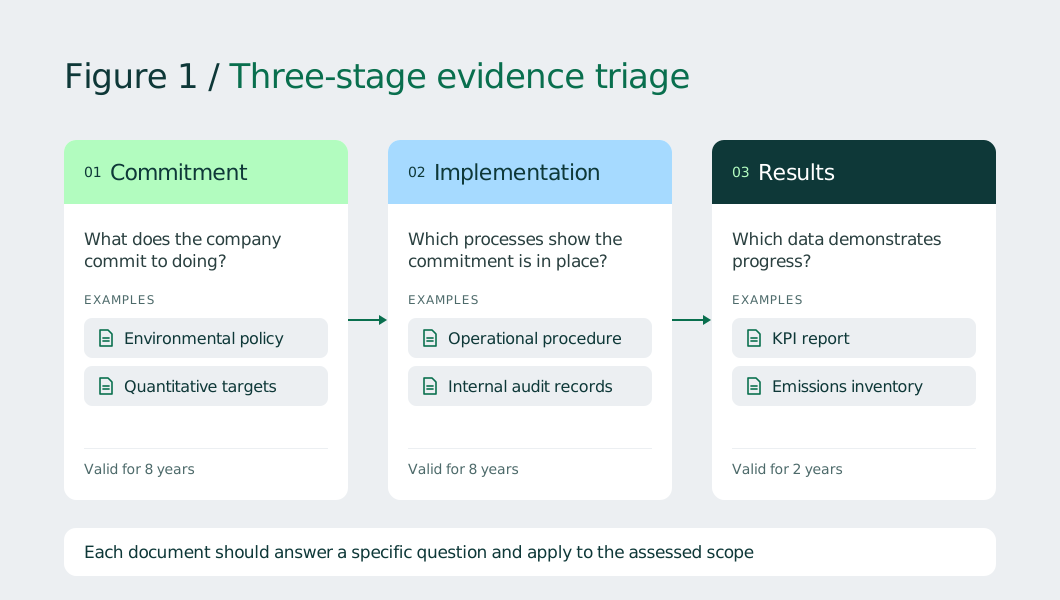
EcoVadis states that policies and actions have an eight-year validity period, while KPI reporting has a two-year validity period.[2] Companies should therefore review older documents before relying on them.
“A document earns its place when it answers the question and shows how the system works.”
Environmental targets often create the most uncertainty. Companies may have ambitions to reduce emissions, energy use, waste, or water consumption. The supporting evidence may still lack a baseline, owner, timeframe, or measurement method.
EcoVadis introduced a Q3 2026 methodology update requiring a baseline year for quantitative targets.[4] This change reflects a wider movement towards comparable, decision useful sustainability data.
A credible target should answer five questions:
The target does not need to cover every environmental topic. It should reflect the company’s most relevant impacts and the level of control it has over them.
This is where EcoVadis scorecard insights can support a more focused improvement plan. The scorecard should help teams identify which management system elements require stronger evidence, clearer objectives, or better reporting.
The most useful trend is a move towards more focused submissions. Companies are asking fewer questions about how to upload more files. They are asking how to make existing evidence more credible and easier to assess.
That shift supports better internal management. A concise policy library is easier to maintain. A clear target framework is easier to communicate. A consistent KPI system makes progress easier to review.
The latest EcoVadis document guide recommends checking document validity, relevance, and alignment with the methodology before submission. [3]
The practical lesson is straightforward. Start with the Environment questions that matter most to the business. Map the available evidence against those questions. Then close the most important gaps before adding more documents.
The Environment theme tests how clearly a company can demonstrate its sustainability management system. Strong performance depends on the connection between commitments, implementation, and measurable results.
A focused evidence review can also strengthen the underlying sustainability journey. It helps teams move from compliance to purpose by making environmental objectives more actionable and accountable.
“The strongest submission reflects how the business operates throughout the year.”
We are an international sustainability consultancy supporting organisations on their journey from compliance to positive impact. As an accredited EcoVadis Strategic Partner since 2018, we support the full EcoVadis journey, from gap analysis and evidence mapping to policy implementation, data collection, assessment completion, stakeholder training, supplier engagement, and scorecard review. Our EcoVadis assessment support helps organisations strengthen their sustainability management systems and turn scorecard findings into practical improvement plans.
Recognised as a Top Brand in sustainability by EUPD and listed among the best ESG consultancies in the Netherlands by Consultancy NL, we help companies prepare stronger submissions, improve their EcoVadis performance, and build lasting sustainability capabilities. Explore our EcoVadis assessment support and book a call with our experts.
[1] EcoVadis. EcoVadis Ratings Scoring Principles: Framework for All Company Sizes and 360° Watch Findings. October 2026. Accessed November 2026.
[2] EcoVadis. Understanding supporting documents. Accessed November 2026.
[3] EcoVadis. Complete Guide for Document Submission. October 2026. Accessed November 2026.
[4] EcoVadis. Methodology Updates Q3 2026. Accessed November 2026.
[5] Nexio Projects. How the EcoVadis scoring system works in 2025. Accessed November 2026.
[6] Nexio Projects. 2026 EcoVadis Insights Report. Slide 29. Accessed November 2026.