 SBTi 2025: Tracking the global shift to science-based climate targets
September 9, 2025


Across the Middle East, sustainability reporting is moving from a voluntary, brand‑led exercise towards more formal, investor‑grade ESG disclosures. Regulators are increasingly aligning with the International Sustainability Standards Board (ISSB) and its IFRS S1 and IFRS S2 standards, while also working to consider and embed interoperability with the Global Reporting Initiative (GRI) and European Sustainability Reporting Standards (ESRS) (1).
Countries within the region are all making moves towards formalising and enshrining ESG reporting requirements in legislation, albeit at different paces and manifesting in different forms. However, the UAE stands out as a major catalyst: its Climate Law translates the national ambitions set in its Net Zero by 2050 strategic initiative into clearer expectations around measurement, reporting, and emissions reduction planning (2)(3). For organisations operating in the region, the objective is becoming increasingly clear: the question is now becoming how and how quickly companies need to approach building reporting-ready ESG data and governance rather than if it should be done at all.
ISSB standards are designed to make sustainability disclosures comparable and decision‑useful for capital markets. Middle East, like many countries across the world, is joining global markets in introducing ISSB‑aligned mandatory sustainability and climate reporting, often through phased implementation (1).
The ISSB’s two core standards provide a common structure:
As the global demand for companies to report and disclose on ESG matters continues growing, there are many country and industry-level differences in reporting approaches and requirements appearing. As many Middle Eastern countries join these developments, it will become increasingly pertinent to consider and intentionally develop policy considering interoperability with some of the main recognised international frameworks such as ESRS and GRI.
These discussions and considerations have already been taking place. For instance, United Nations Environment Programme Finance Initiative’s (UNEP FI) regional programme explicitly frames the discussion as one of implementation and interoperability across ISSB (IFRS S1/S2), ESRS, and GRI, particularly in Africa and the Middle East (1). For businesses, the practical takeaway is that reporting architectures need to be designed to serve multiple frameworks without duplicating effort.
The UAE Climate Law (Federal Decree‑Law No. 11 of 2024 on the Reduction of Climate Change Effects) is presented as a major step in the UAE’s sustainability agenda, aligned with the country’s commitment to net zero emissions by 2050 (2)(3). It marks a shift from climate targets being primarily strategy‑led to being increasingly execution‑led through compliance expectations.
The law is described as applying across public and private sectors, including entities operating in free zones, with further sector‑specific requirements and detailed guidance expected through UAE Ministry of Climate Change and Environment (MOCCAE) (3).
The UAE Federal Decree-Law No. 11 of 2024 on the Reduction of Climate Change Effects applies to essentially all types of entities operating in the UAE across all seven Emirates, both in mainland and free-zones. The decree covers government bodies, public entities and private sector organisations. While the law is intentionally broad, first focus will be on high-emitting activities such as energy-intensive industries like oil and gas, steel and heavy manufacturing, utilities and also large real-estate portfolios to name a few examples. This extensive reach promotes collective climate accountability.
Importantly, it offers no exemptions by company size or industry, so SMEs, manufacturers, service businesses, and tech startups alike must adhere to its requirements. This broad scope matters commercially because it expands the likely compliance perimeter beyond a narrow subset of regulated entities.
Across your sources, the core expectations are consistent:
The law came into force on 30 May 2025 and will be implemented in phases, with more detail expected to follow through MOCCAE guidance (3). Penalties can be severe, with administrative fines cited from AED 50,000 up to AED 2 million, and potentially higher for repeated or serious breaches depending on enforcement pathways (3)(4).
The current reality is clear: Mandatory reporting is being phased in across markets such as the UAE, Oman, Jordan, Qatar, and Kuwait, while Saudi Arabia and Bahrain are encouraging adoption through guidance and expectation‑setting. In practice, this often means targeting high-polluting activities as a starting point, followed by a gradual expansion across all other industries, company sizes and to non-climate disclosures as well.
Oman’s Muscat Stock Exchange requires listed companies to publish ESG reports aligned with GRI and GCC metrics starting 2025. As part of Oman Vision 2040’s broader sustainability and economic diversification agenda (5), regulators are developing direction towards IFRS S1 and S2, signaling a shift from impact narratives towards financially relevant, decision‑useful risk disclosure (4). While mandatory ESG disclosure requirements for listed companies exist, the importance of aligning with both local mandates and international frameworks is significant (6).
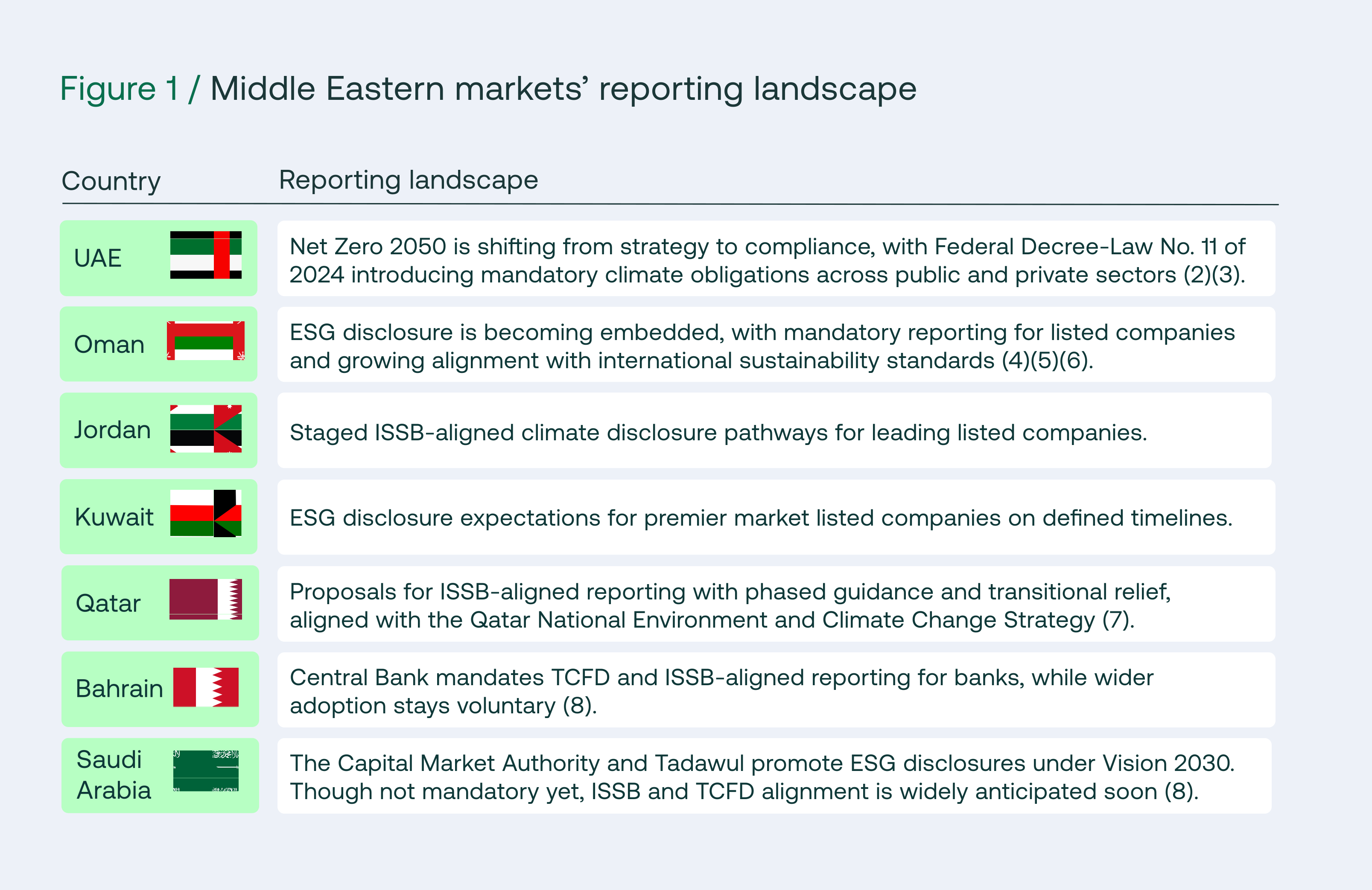
The key point is not that every market is “there” yet, but that policy intent and capital‑market pressure are pushing in the same direction. Additionally, the UAE being a regulatory frontrunner in the region is spurring movement across neighboring countries which will aid competitiveness and raise the bar collectively across the region.
As reporting matures, assurance becomes the next constraint. There’s a regional trend towards limited assurance over Scope 1 and 2 becoming more common over time. While this is already in place for the UAE and Oman, for other countries like Jordan and Qatar, it’s a significant topic of discussion and is expected to be integrated as part of developing requirements. This shifts the focus from producing a report to running a controlled process with clear ownership, documentation, and repeatable methods.
As climate reporting becomes more standardised and assured, early movers can strengthen credibility with lenders, investors, and customers. ISSB‑style disclosure is designed to be decision‑useful for capital markets, and regional policy discussions are explicitly linked to sustainable finance implementation (1). Companies adopting early compliance can tap into green financing options like sustainability-linked loans and ESG-aligned bonds. Lenders are increasingly factoring climate risks into credit evaluations, so adherence may unlock better borrowing conditions.
Reducing emissions also drives cost efficiencies, particularly for energy-heavy industries. By shifting to renewables or boosting efficiency, firms cut expenses while fulfilling legal obligations. The law bolsters brand image too. With eco-aware consumers on the rise, compliance builds trust and customer loyalty.
Its push for innovation opens business avenues. Companies pioneering climate tech or services could gain government perks or tap emerging markets. Plus, as global supply chains raise ESG bars, compliant firms stand out for international deals and trade.
All of these factors create a clear business case for acting early: stronger readiness can support better financing conversations, risk mitigation and competitive expansion, while reducing friction in due diligence.
Nexio Projects supports organisations on their journey from compliance to purpose, helping translate sustainability ambitions into concrete actions through expert support in ESG ratings, climate strategies, and sustainability reporting. The team has delivered 1,000+ projects for 400+ clients across 20+ countries, covering 25+ sectors, including shipping and logistics, manufacturing, chemicals, and consumer goods.
For organisations building credible Net Zero programmes, Nexio Projects can support end‑to‑end climate action delivery, including:
For organisations facing growing expectations under ISSB, GRI, ESRS, or CSRD‑style requirements, Nexio Projects can help build a reporting process that is robust, repeatable, and audit‑ready, including:
Ready to join the momentum? If you’re looking to take action for your ESG reporting and net zero targets, contact us for a free consultation with our experts.
You can sign up to our newsletter for more ESG reporting updates, trends and strategies.
(1) United Nations Environment Programme Finance Initiative (UNEP FI) (2023) Regional Implementation of Sustainability Reporting Standards in Africa and the Middle East. Available at: https://www.unepfi.org/regions/africa-middle-east/regional-implementation-of-sustainability-report-standards-in-africa-and-the-middle-east/ (Accessed: 12 February 2026).
(2) UAE Government (n.d.) The UAE’s Net Zero 2050 Strategy. Available at: 2050 (Accessed: 12 February 2026).
(3) Zevero (n.d.) UAE Climate Law: what businesses need to know. Available at: https://www.zevero.earth/blog/uae-climate-law (Accessed: 12 February 2026).
(4) The Sustainability Cloud (2026) ESG Regulations Oman: Why Strategic ESG Reporting Matters. Available at: https://www.thesustainabilitycloud.com/blog/esg-regulations-oman/ (Accessed: 12 February 2026).
(5) Oman Vision 2040 (n.d.) Oman Vision 2040. Available at: https://www.oman2040.om/ (Accessed: 12 February 2026).
(6) Crowe Oman (n.d.) Sustainability & ESG. Available at: https://www.crowe.com/om/services/sustainability-and-esg (Accessed: 12 February 2026).
(7) Ministry of Environment and Climate Change, Qatar (n.d.) Qatar National Environment and Climate Change Strategy. Available at: https://envsustainability.mecc.gov.qa/en (Accessed: 12 February 2026).
(8) Saudi Arabia Vision 2030 (n.d.) Saudi Vision 2030. Available at: https://www.vision2030.gov.sa/en (Accessed: 12 February 2026).