 How to leverage LCA insights?
April 14, 2025


Building a strong EcoVadis submission is not a oneoff task but an ongoing journey that evolves with your organisation. EcoVadis scores become more competitive every year, as medals are reserved for companies in the top performance percentiles, making what counted as good practice yesterday to be average tomorrow.
To keep pace, it helps to think in terms of two complementary pathways: strengthening your sustainability management system and executing each EcoVadis Assessment with precision. Over time, these approaches naturally blend into a cycle of continuous improvement rather than a rush before the deadline.
EcoVadis has become a central reference point for customers, investors, and partners who want to understand how seriously companies take sustainability. A strong EcoVadis rating can help you:
These benefits are amplified when you treat the assessment as part of a broader sustainability strategy rather than just a customer-driven requirement. Over time, this integrated approach can also support ambitions to move towards EcoVadis certification at higher medal levels.
Treating EcoVadis as a journey changes how you approach each cycle. Instead of focusing only on this year’s questionnaire, you start to see every submission as an opportunity to refine your strategy, documentation, and data. This mindset is essential because the methodology evolves:
A submission that once secured an EcoVadis gold medal might not be enough in future years if your organisation stands still. If the longterm goal is to approach a platinum level performance, incremental improvements need to be woven into business planning, budgeting, and governance, not left until the platform opens.
Sign up to our upcoming EcoVadis webinar, where our experts will break down the latest changes of 2025.
The first pathway begins with understanding your current position. This “gapfirst” approach focuses on your sustainability management system across all EcoVadis themes:
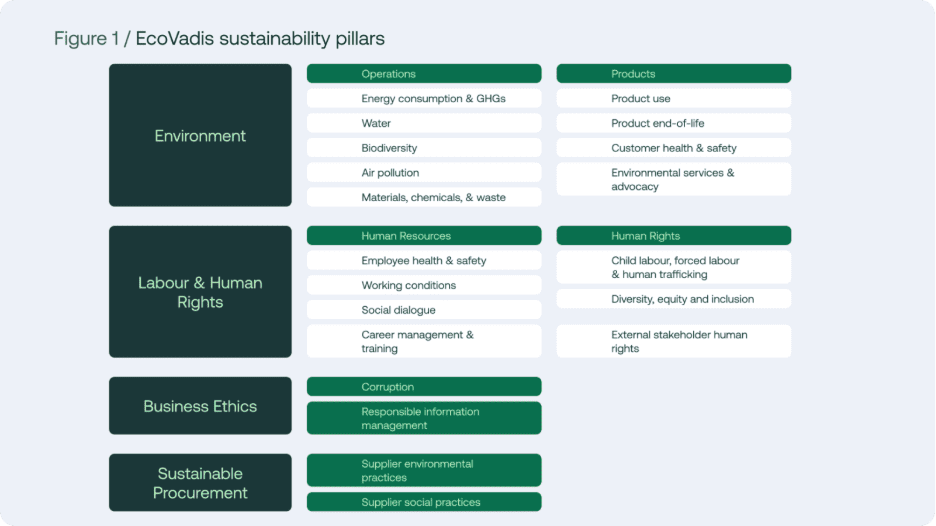
Practical steps include:
This diagnosis helps you see both strengths to highlight and areas that require more structure before the next EcoVadis assessment.
Your current performance can be used as a baseline for improvement. Instead of looking only at the overall EcoVadis score, break down the results to understand:
From there, you can design an improvement roadmap over several cycles rather than aiming to fix everything at once. This roadmap then guides how you allocate resources between policies, actions, training, and data systems.
To make the analysis useful, it helps to translate the findings into a phased plan that matches your organisation’s pace and resources. Rather than trying to address everything at once, you can distinguish between actions that are urgent, those that are important but require more preparation, and longer-term initiatives that support broader strategic ambitions.
The specifics of that plan will look different for every business, but the aim is the same: to move from isolated efforts towards a more coherent and resilient sustainability management system. Over time, this structured approach is what underpins meaningful progress and supports a steadily improving EcoVadis score without disclosing every operational detail in advance.
The second pathway focuses on delivering a high quality submission this year. Even organisations with strong sustainability practices can lose points if their submission is incomplete or unclear. Treating the assessment as a structured project helps to:
A simple project plan might include phases such as scoping, data and document collection, drafting, internal review, and final approval. This discipline is especially useful when customer deadlines are tight.
Effective evidence management is at the heart of Building a Strong EcoVadis Submission. Instead of asking colleagues for “anything related to sustainability”, use targeted requests:
When done well, this work also improves internal information management and makes it easier to respond to other stakeholder requests. A well curated evidence library can directly support improvements in your EcoVadis scorecard insights over multiple assessment cycles.
When preparing your EcoVadis submission, use the Policies–Actions–Results (PAR) framework as a simple structure for telling your sustainability story. This approach helps reviewers clearly see the link between what your organisation commits to (policies), how those commitments are put into practice (actions), and the outcomes achieved (results).
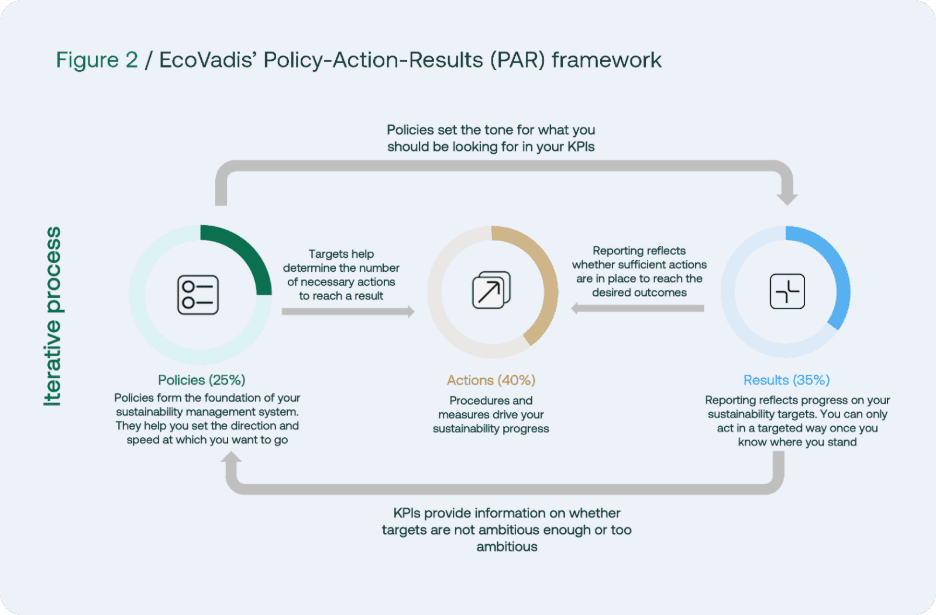
Strong responses typically:
Presenting information in a clear, structured way helps reviewers understand your organisation’s approach and award points confidently. It also makes it easier for internal stakeholders to see how their work contributes to overall sustainability performance and the EcoVadis score.
Although presented separately, the system strengthening pathway and the execution-focused pathway are two sides of the same coin. In the initial years of responding to EcoVadis, many organisations lean more heavily on the completion side to respond quickly to customer requests or demonstrate initial progress. As they gain familiarity with the platform and methodology, they often recognise deeper structural gaps that need to be addressed through a more strategic, gap driven approach.
Over time, the most effective organisations combine both pathways into a continuous loop:
For some companies, the immediate priority is to secure a first rating or maintain a current level while responding to multiple customer invitations. For others, the focus shifts towards using EcoVadis as a management tool to drive long-term transformation. In both cases, treating EcoVadis as a journey ensures that progress does not stop once the questionnaire is submitted.
As your organisation matures, ambitions may grow, from establishing a baseline score, to aiming for an EcoVadis Rating that reflects sector leadership and supports commercial objectives. Over several cycles, this might mean gradually strengthening governance, clarifying targets, and improving how outcomes are measured and communicated. Ultimately, the goal is for EcoVadis to mirror your broader sustainability evolution rather than existing as a separate, one-off exercise.
Nexio Projects supports both pathways with tailored solutions, ensuring organisations receive exactly the level of support they need at every stage of their EcoVadis journey.
For organisations focused on strengthening their system before submission, the journey typically starts with a structured gap analysis. Nexio Projects assesses your current processes and evidence against EcoVadis expectations, identifying both quick wins and deeper structural opportunities. From there, we help build practical roadmaps that strengthen your sustainability management system in a way that is realistic, prioritised, and aligned with your business strategy.
For organisations prioritising precision in the current assessment, Nexio Projects offers an effective submission solution delivered by experienced team members. This approach focuses on project management, targeted evidence collection, document quality checks, and the crafting of clear, consistent responses. The goal is to maximise your score based on your current maturity, while also improving your internal processes for future cycles.
Together, these two approaches form a connected, long-term journey.
With Nexio Projects’ journey-based approach, each EcoVadis assessment becomes more about confirming your organisation’s progress already underway. Your submission begins to tell a consistent and credible story: policies backed by action, action evidenced by data, and data used to refine priorities. In this way, building a strong EcoVadis submission becomes an annual checkpoint within a much broader sustainability journey, strengthening stakeholder trust and internal alignment over time.
EcoVadis and beyond, Nexio Projects brings clarity to every aspect of the sustainability journey, from reporting to strategic implementation, ensuring that each assessment cycle builds on the last. Our team of experts supports organisations across industries and maturity levels, helping them take confident next steps. On average, clients working with Nexio Projects have achieved an overall EcoVadis score improvement of 10.7 points, supported by more than 600 EcoVadis projects successfully delivered and recognition as the number one global EcoVadis strategic partner.
Want to discuss your EcoVadis strategy with our experts? Contact us today to get personalised guidance.
For the latest ESG updates, including EcoVadis trends and best practices, subscribe to our monthly newsletter.