
January 27, 2026

EcoVadis scorecard: How to read, share & maximise your rating 

Complete guide to decoding your EcoVadis rating, sharing best practices, and rapid improvement strategies
Stephanie Pragastis
Senior Sustainability Consultant & Trainer
11 min read

“Your EcoVadis scorecard isn’t just a rating. It’s your sustainability strategy mapped for customers, investors, and continuous improvement.” 

EcoVadis has become a key standard for rating corporate sustainability performance. For many suppliers, the EcoVadis score is now a commercial requirement rather than a “nice to have”. Yet the scorecard itself can feel opaque the first time you see it. This article explains how to read it, how to share it, what it costs, how long it is valid for, and what a “good” score actually looks like. 

The result of an EcoVadis assessment comes in the form of a scorecard, ranging between 0–100, with detailed performance across four themes: Environment, Labour & Human Rights, Ethics, and Sustainable Procurement.  
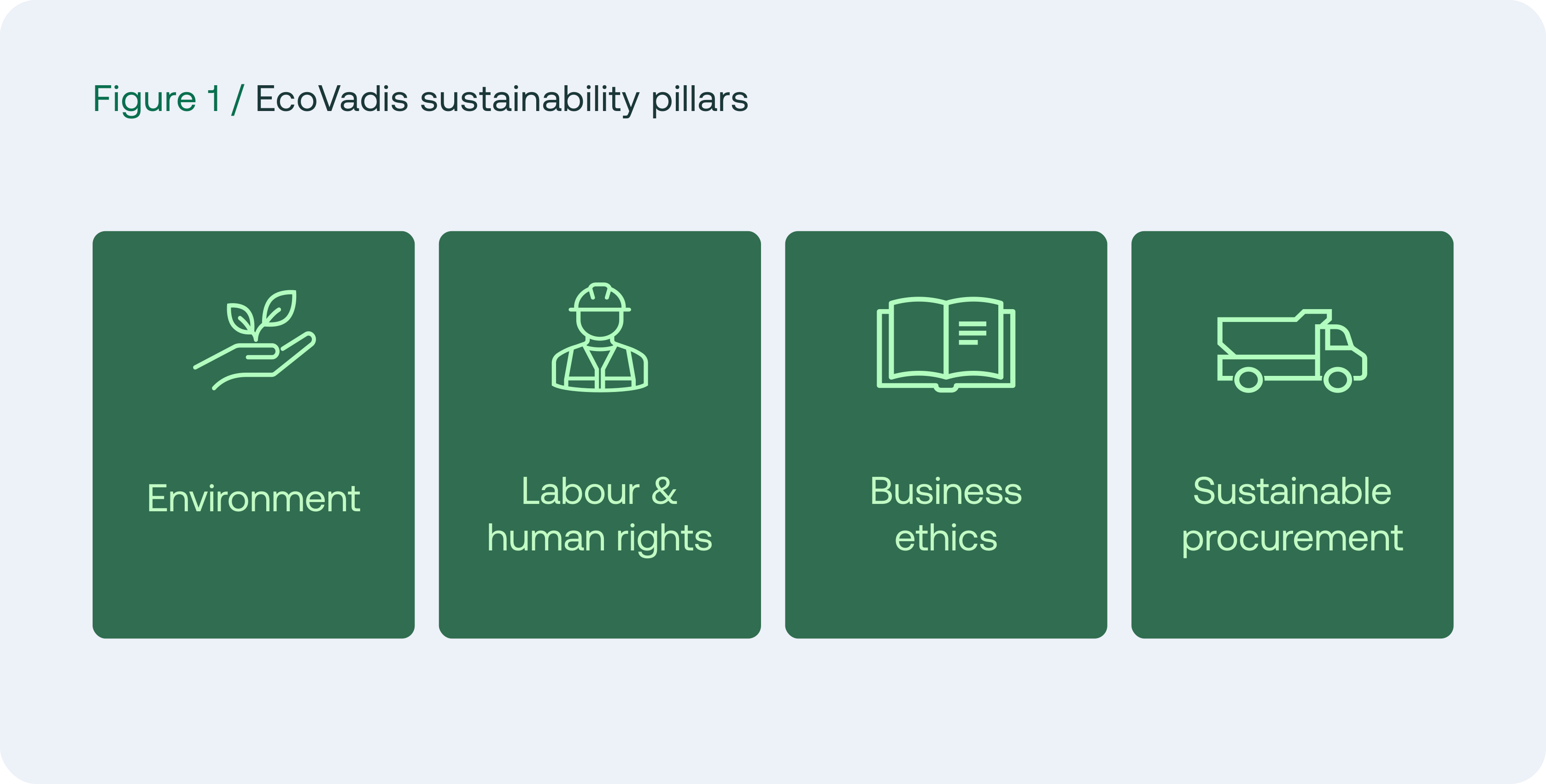
EcoVadis sustainability pillars of environment, labour & human rights, ethics and sustainable procurement

Large buyers increasingly rely on these ratings to integrate sustainability into procurement, while suppliers use these to demonstrate performance, identify gaps, and structure improvement plans (1). 

How to read your scorecard 

The scorecard is designed to give you a structured view of your sustainability management system. At the top, you see: 
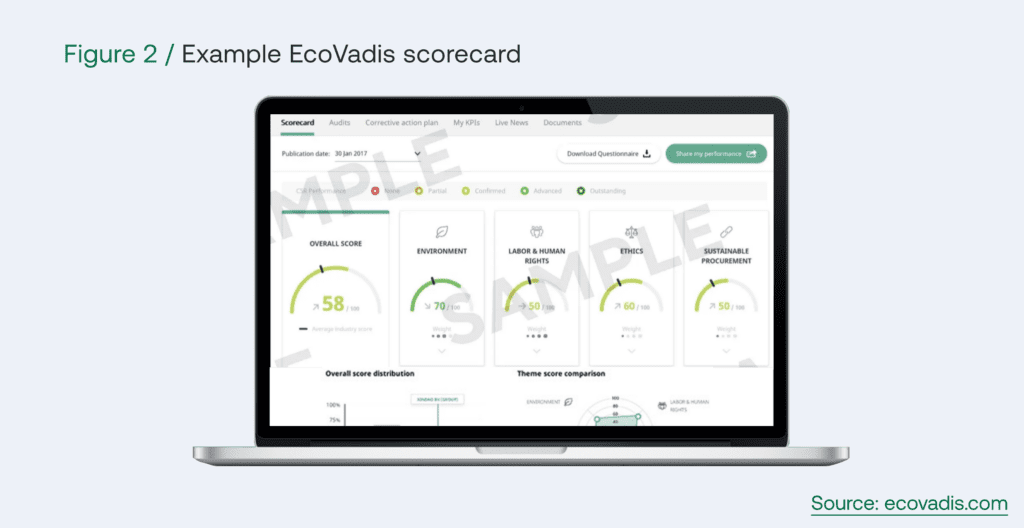
  • An overall EcoVadis score (0–100) 
  • Your percentile, meaning how you scored compared to all other organisations who completed the assessment 
  • Your medal, if you fall in the top 35% or higher 
Example of an EcoVadis scorecard

Beneath that, scores are broken down into the four themes. Each theme is built on the Policies–Actions–Results (PAR) framework (1): 

  • Policies: Formal commitments such as policies, codes of conduct, and certifications 
  • Actions: Programmes, procedures, training, and implementation evidence 
  • Results: KPIs, performance trends, audit results, and external reporting 

Additional resource: You can read more about how EcoVadis can strengthen your sustainability management system in our blog here. 

A strong score usually shows a balanced profile: clear policies, robust actions, and measurable results in at least the most material themes for your sector. When you look at your EcoVadis scorecard insights, focus first on: 

  • Themes where your score is significantly lower than others 
  • Themes that have the highest impact on your overall score 
  • Themes that have gone down since your last assessment 

What makes a good EcoVadis score?

A “good” score depends on your sector, your customers’ expectations, and your maturity level, but there are widely used thresholds: 

  • Below 45 – Basic or emerging system, often with partial coverage and limited results 
  • 45–64 – Structured system, usually acceptable to many customers but with clear improvement needs 
  • 65–84 – Strong system backed by evidence and results; often in medal range 
  • 85+ – Leading practice; usually aligned with best‑in‑class expectations(1) 

EcoVadis also awards medals based on your score and absence of major controversies (1): 
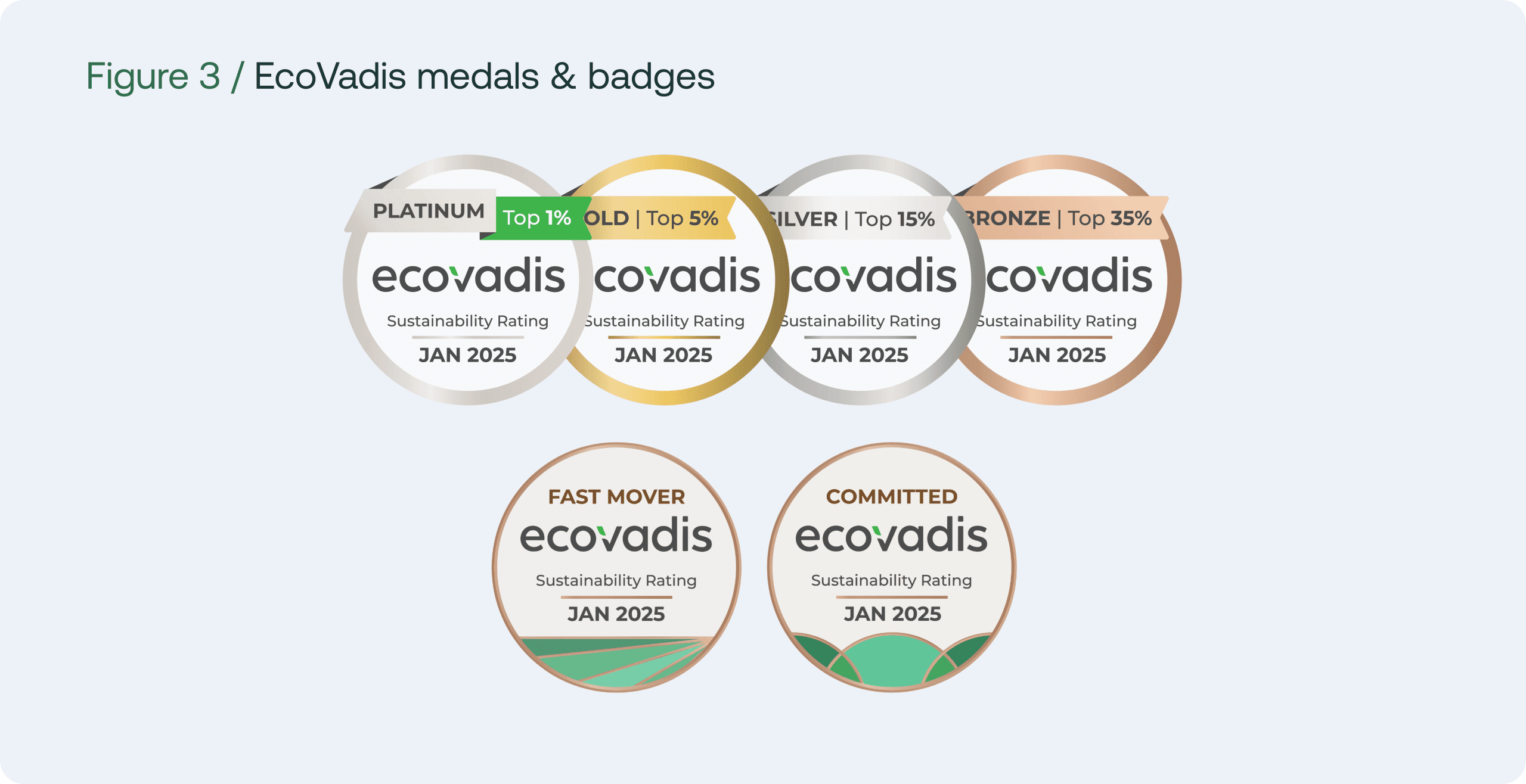
  • Bronze – Top 35% of all rated companies 
  • Silver – Top 15% of all rated companies 
  • Gold – Top 5% of all rated companies 
  • Platinum – Top 1% of all rated companies 
EcoVadis medals and badges for sustainability

From a commercial perspective, many multinationals now view EcoVadis Platinum, Gold or Silver as a strong positive signal in supplier selection, especially in high‑risk categories.  

How long is your scorecard valid?

An EcoVadis scorecard is valid for 12 months from the date of publication (2). This reflects the expectation that sustainability performance, data, and documentation should be updated annually. After 12 months: 

  • Customers may be notified that the score is no longer current 
  • You will receive reminders to launch a new EcoVadis assessment 
  • Some buyers will treat an out‑of‑date scorecard as a non‑compliance and request an updated one 

In certain cases, especially for higher scores and lower risk profiles, customers may accept reassessment on a 24 month cycle. However, EcoVadis only considers a scorecard valid for 12 months, meaning that customer requirements ultimately determine whether a longer reassessment cycle is acceptable (2). As a rule of thumb, reassess at least once a year if: 

  • Sustainability is part of your commercial value proposition 
  • You are working towards specific targets (e.g. net zero, human rights due diligence) 
  • Key customers are actively tracking your score over time 

How to share your EcoVadis scorecard

Sharing your EcoVadis scorecard goes beyond simple administration. It’s a powerful commercial opportunity to demonstrate sustainability leadership and gain market advantage. With 90% of global companies now requiring EcoVadis assessment from suppliers (3), your rating has become table stakes for market participation, while medal status signals competitive differentiation. 

Three primary sharing methods are (3): 

  • Direct platform sharing: Accept customer requests or proactively invite key buyers to view your scorecard through EcoVadis’ secure network 
  • Secure links/platform access: Generate view-only links for stakeholders to explore your EcoVadis scorecard insights and corrective action plan 
  • PDF exports: Use scorecard PDFs in tenders, sustainability reports, sales collateral, and investor communications 

Some strategic sharing practices that we recommend to maximise impact involve: 

  • Internal alignment across procurement, sales, and sustainability teams ensures consistent messaging about your score, medal, and improvement roadmap. 
  • Proactive storytelling pairs your rating with your corrective action plan, particularly for weaker themes, demonstrating transparency and commitment to progress. 
  • Customer-facing enablement equips sales and key account managers to articulate how your EcoVadis certification delivers value—meeting procurement requirements, reducing audit burden, and providing verified ESG performance. 
  • Multi-channel amplification showcases medals prominently on websites, proposals, and ESG reports while using industry benchmarks to contextualise your performance. 

Additional resource: Learn how leading organisations transform EcoVadis ratings into market advantage in our on-demand session here. 

What and when do you pay for EcoVadis? 

EcoVadis operates on an annual subscription model. What you pay depends on company size, scope, and the subscription tier you choose, but the key points are consistent (2): 

  • You pay an annual fee that covers one assessment per year, access to the platform, and your scorecard 
  • The fee is charged when you launch or renew your assessment, or if your current subscription comes to an end  
  • Higher tiers include additional functionality (e.g. more connected customers, advanced analytics, multi‑site options) 

While pricing details change over time, it is useful to treat the subscription as an ongoing investment rather than a one‑off cost. Many organisations embed the EcoVadis fee into: 

  • Their broader ESG budget (alongside reporting, verification, and consultancy) 
  • Their supplier qualification and risk management costs 
  • Frameworks tied to customer expectations or contractual obligations 

From Nexio Projects’ experience, companies get the best value when they plan the year around their assessment date, using the months before launch to close gaps and avoid rushed, low‑quality evidence. 

How to read your EcoVadis scorecard structure

Beyond the headline figures, the structure of the scorecard itself can guide your improvement journey. Typically, you will see: 

  • Theme‑by‑theme scores, usually with graphs comparing you to your sector and region 
  • A breakdown of Policies, Actions, Results, often colour‑coded to show strengths and weaknesses 
  • A list of strengths, where your practices meet or exceed expectations 
  • A list of improvement areas, which form the basis of your corrective action plan 

Tips for efficiency 

  • Start with your strongest theme to understand what “good” looks like in your own context 
  • Then examine the weakest theme, especially if it is material to your sector (e.g. Environment for manufacturing, Labour & Human Rights for labour‑intensive supply chains) 
  • Use the improvement areas as a roadmap: each bullet usually corresponds to a specific missing or weak document, practice, or result 

Additional resource: Read more about strengthening your Ecovadis performance in our article here. 

How to improve your EcoVadis score 

Improvement starts with treating your scorecard as a management tool, not just a rating. Strong performers usually do three things consistently: 

  • Close evidence gaps: they ensure every relevant policy, procedure, and certification is up to date, clearly worded, and properly uploaded 
  • Strengthen implementation: they move beyond statements to documented training, audits, and processes that show real deployment 
  • Measure results: they track KPIs, set targets, and demonstrate year‑on‑year change in key areas such as energy use, diversity, or supplier audits 

Typical “quick wins” include: 

  • Publishing or updating a code of conduct, policy, standard or commitment in line with international standards 
  • Formalising existing practices (e.g. health & safety training, supplier screening) into documented procedures 
  • Starting to report basic performance metrics that you already track informally 

Over time, your EcoVadis certification becomes a credible external validation of this underlying system rather than a stand‑alone badge. 

FAQ 

What is EcoVadis used for by customers? 

Customers use your EcoVadis score to: 

  • Screen and segment suppliers by sustainability risk 
  • Set minimum thresholds (e.g. Bronze or Silver) for preferred supplier status 
  • Monitor improvement over time and align with their own ESG targets 

Can you challenge or clarify your score? 

Yes. After receiving your scorecard, you can request clarification or a debrief within a defined timeframe (3). This does not guarantee a revised score, but it can clarify interpretation, highlight misunderstandings, and guide your next improvement cycle. 

How often should you be reassessed? 

Annually is best practice if your customers rely on your rating or if you use the scorecard to track progress. Reassessment every 12 months ensures your EcoVadis assessment reflects the latest data, policies, and initiatives. 

What is the EcoVadis scorecard used for internally? 

Internally, companies use the EcoVadis scorecard to benchmark their sustainability performance, identify strengths and improvement areas across the four themes, and prioritise corrective actions. The detailed breakdown, suggested improvement areas, and benchmarking against industry peers help build a structured roadmap for continuous ESG improvement and track progress year over year. 
 

Nexio Projects’ EcoVadis support 

As a pure‑play sustainability and climate consultancy, Nexio Projects supports organisations end‑to‑end on EcoVadis. From first‑time assessments and evidence mapping, to scorecard debriefs, corrective action planning, and long‑term score improvements, Wwe support EcoVadis journeys tailored to your organisation’s needs. Work typically spans: 

  • Identifying gaps in your sustainability management system for first time or re-assessment 
  • Interpreting EcoVadis scorecard insights for boards and commercial teams 
  • Designing practical roadmaps to move to maximised scores 
  • Integrating EcoVadis work into broader ESG, net zero, and sustainable procurement strategies 
  • Structuring sustainability management systems, including policies and procedures 

If you want to move beyond simply “having a score” to using EcoVadis as a driver of change and commercial value, this is where external support can accelerate your journey. 

For the latest ESG updates, including EcoVadis trends and best practices, subscribe to our monthly newsletter. 

Contact us to build your sustainability management journey by EcoVadis experts trained for tailored support.

References 

(1) EcoVadis (2025) What is EcoVadis and how does it work? (Company overview and methodology). 
(2) EcoVadis Support (2024) What happens after you get a scorecard? Available at: EcoVadis Help Centre. 
(3) EcoVadis Support (2024) How can I share my EcoVadis Scorecard? Available at: EcoVadis Help Centre. 

Stephanie Pragastis
Senior Sustainability Consultant & Trainer
Share
Get in touch with our experts
Contact us
Jatin Budhraja
Sustainability Advisory Lead
9am to 5pm, Monday to Friday
Replies within 24 hours