Understanding ESRS
January 31, 2025


“A reporting platform adds value when it makes accountability visible, evidence traceable, and review cycles repeatable.”
Choosing a CSRD reporting software is becoming a board-level decision for companies that need reliable sustainability information. Sustainability information now carries the same expectations of reliability as financial information, and the system that produces it has to connect data owners, reporting teams, finance, management and assurance providers in a single, auditable chain.
A platform alone does not create a credible report. Credibility comes from the reporting system that sits around the platform: your reporting boundary, material topics, data definitions, data collection processes, controls and approval process. The software must reflect that reporting system accurately, and continue to do so as requirements, boundaries, and reporting frameworks change.
Nexio Projects supports CSRD implementation and sustainability reporting for organisations across Europe with international value chains. Having delivered more than 600 sustainability projects, our teams have seen which system decisions hold up under assurance and which create work later.
The first test is operational: can the software turn a reporting requirement into a controlled workflow? A capable system should assign each datapoint to an accountable owner and record the definition, boundary, source, calculation method, evidence, reviewer, and approval status against it. It should also show unresolved gaps on its own rather than leaving the reporting team to reconcile parallel spreadsheets to find them.
The second test is adaptability, and the regulatory backdrop explains why. The European Commission adopted revised European Sustainability Reporting Standards on 3 July 2026, reducing and simplifying disclosures requirements while preserving the core architecture of sustainability reporting. The evolving landscape of sustainability reporting, makes adaptability of softwares important.
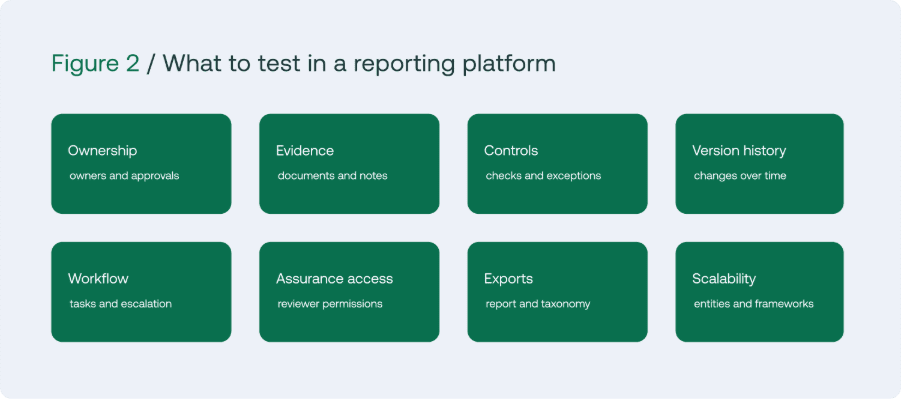
Select a software that can update datapoint libraries, maintain version history, and preserve an audit trail when requirements change, without a reconfiguration project each time.
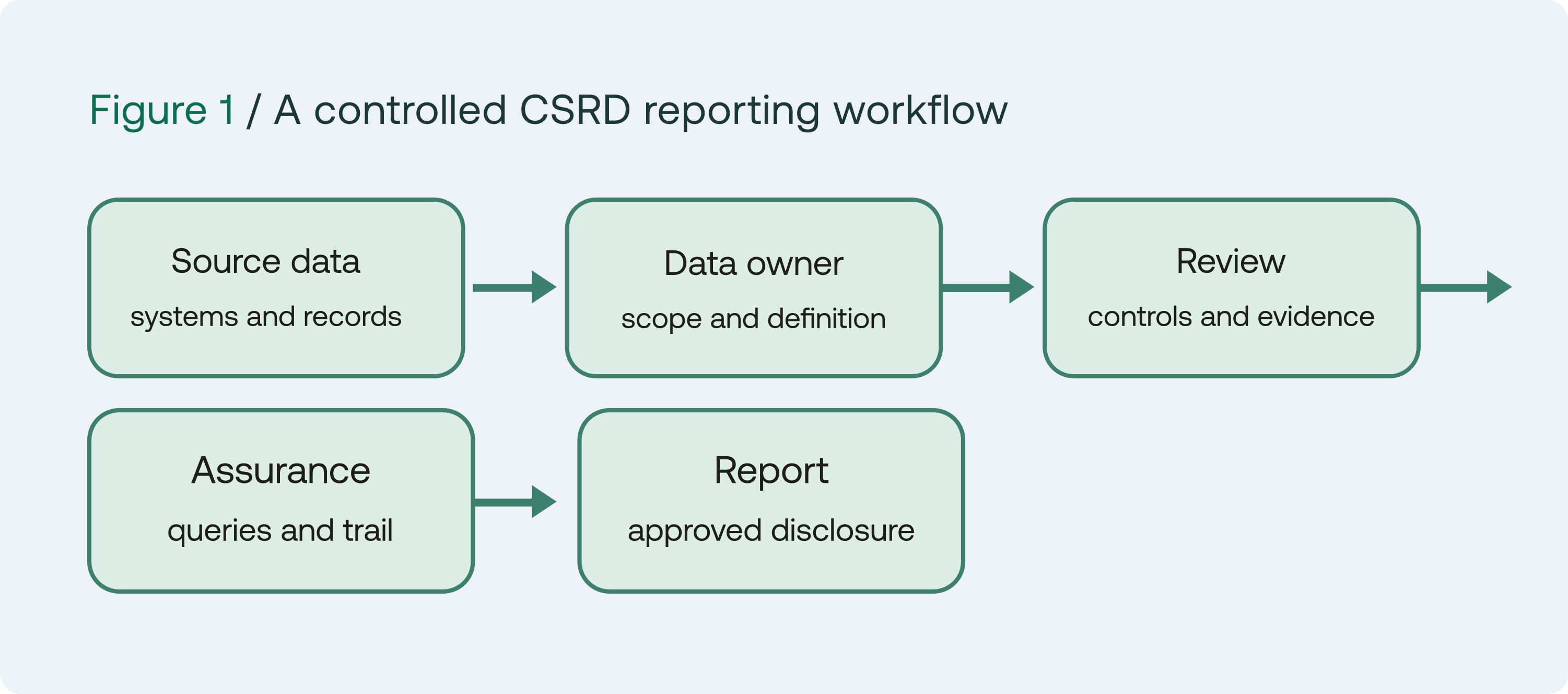
A reporting tool should make ownership explicit through role-based access, task assignment, escalation reminders, review stages, and approval records.
The most effective workflows mirrors how the organisation already operates. Procurement owns supplier data, human resources owns workforce data, and finance validates financial links and reporting boundaries. The sustainability team’s role is to coordinate that process, not to become the default owner of every input. Software that quietly concentrates all data entry in one team will not survive its second reporting cycle.
Every disclosure or data point in the report must be supported by evidence that a second person can review independently. Check whether the platform stores source documents, comments, calculation notes, control checks, and change history alongside the datapoint itself, rather than in adjacent folders and inboxes.
The system should also distinguish clearly between measured values and estimates. That distinction helps management decide where better data will reduce reporting risk, and to invest accordingly.
Ask how the system handles the final reporting workflow. This includes report structure, data export, tagging requirements, consolidation, and access for assurance providers.
The EFRAG implementation guidance emphasises practical application of the ESRS architecture, including materiality assessment, value chain information, and datapoint interpretation. [2] Your software should help teams apply those concepts consistently across entities and reporting cycles, not simply store the results.
“The most expensive software decision is choosing a platform before the company agrees how information should be owned and approved.”
Ask the provider to demonstrate a complete reporting cycle: how a reporting owner receives a task, uploads evidence, explains an estimate, and submits the datapoint for review. Then check how a reviewer can reject/approve the submission and request clarification. The system should retain that history without creating a separate email trail.
Test consolidation as well. Add a subsidiary, change its reporting boundary, and check how the platform carries the change into the group view. A system that works for one legal entity may create significant manual work at group level.
Finally, ask how the implementation plan handles the transition from the first reporting cycle to the next – which controls will become recurring, which data owners need training, and which gaps require investment. This turns a one-time project into a repeatable reporting capability.
Software configuration is one part of the work. An implementation partner should help define the reporting model, map data points to owners and sources, design controls, and prepare teams for the first reporting cycle.
Review the partner’s delivery model before selecting a provider. Ask who will lead data discovery, how legal entities and subsidiaries will be included, and how finance and internal audit will participate. Ask how the process will handle incomplete source data, changing definitions, and late reviews.
Also clarify what your organisation will own after implementation. A successful project should leave behind defined responsibilities, documented controls, trained data owners, and a process that your teams can run without continuous external support.
Configuration changes settings and workflows inside the software, while implementation changes how the organisation collects, reviews, approves, and retains information around the software. That distinction determines whether the system remains useful after the first reporting cycle.
A 90-day plan can provide a practical first test of the reporting model. It should be treated as an implementation view, rather than a universal deadline for completing the entire reporting process.
Confirm the following as a first step:
The main output should be an agreed reporting model and a clear list of implementation tasks.
The team should also check whether the workflow reflects how information moves between data owners, sustainability, finance, management, and assurance providers.
Run a mock reporting close. This means rehearsing the collection, review, approval, and exception management process before the full reporting cycle begins. Document unresolved issues and train the teams responsible for recurring updates.
This sequence creates a useful decision point before the full reporting cycle. It helps management distinguish between technology limitations, unclear ownership, incomplete source data, and weaknesses in the reporting process.
The software should support this learning process. It should make exceptions visible, preserve approval decisions, record version history, and allow teams to update workflows without rebuilding the reporting model.
Start with a short test pack based on your organisation’s actual reporting model. It should cover four areas: an environmental metric, such as Scope 1 and 2 emissions; a workforce metric, such as employee turnover; and a governance disclosure.
Ask each provider to demonstrate the complete workflow. The demonstration should begin with a source record and end with an approved disclosure.
It should show how a data owner submits information, attaches supporting evidence, explains an estimate, and responds to review comments. This gives you a better view of the system than a presentation of individual features.
Ask the provider to show what happens when:
• a value changes
• a supporting document is missing
• a reviewer misses a deadline
• a data point needs to be revised
This will show whether the platform maintains version history, keeps evidence with the submission, escalates outstanding reviews, and records the reason for each change.
The demonstration should also show how the platform manages consolidation. Add a subsidiary, change its reporting boundary, and check how the change appears in the group view.
A system that works for one legal entity may create significant manual work at group level.
Finally, compare what each provider includes in the implementation plan. Check which controls will become recurring, which data owners need training, and which gaps require further investment.
A lower software price can create higher internal workload when process design, training, and controls are excluded.
The questions raised during the demonstration should also shape the business case. They show where the software can reduce manual work, what support implementation will require, and which costs sit beyond the licence fee.
Frame the business case around three outcomes: reduced rework, lower reporting risk, and reusable data.
Quantify the current effort involved in maintaining parallel spreadsheets, reconciling subsidiaries, requesting evidence, correcting data, and preparing information for review. Include the time spent resolving unclear ownership and rebuilding processes when definitions or reporting requirements change.
CSRD reporting software should reduce uncertainty across the reporting cycle, from data collection to approval and assurance. The right choice combines usable technology with clear ownership, controlled evidence, repeatable workflows, and practical implementation support.
Treat the purchase as a decision about the reporting operating model. The system should support the current reporting cycle and make the next one easier because the organisation has learned, documented, and improved.
“A reporting system earns its value when the next cycle requires less reconstruction, fewer unanswered questions, and less manual checking.”
At Nexio Projects, we help organisations build reporting processes that connect clear ownership, reliable evidence, and workable controls. We guide organisations on their sustainability journey from compliance to positive impact.
When software is part of the solution, we can help you assess and implement a suitable CSRD reporting platform. Our software partners include Salacia Solutions, Sweep, Position Green, and F19 Digital Reporting. Our experienced consultants understand how these platforms work in practice and can connect their capabilities to your reporting model, data owners, controls, evidence requirements, and implementation plan. You can explore our software and technology partners.
Recognised as a boutique ESG strategy provider by Verdantix and as the best ESG consultancy in the Netherlands in 2025 by Consultancy NL, we can help you compare suitable platforms and build a reporting process that works beyond the first cycle.
Book a reporting systems discussion to discuss your software options and implementation needs.
[1] European Commission. Commission adopts revised sustainability reporting standards. https://finance.ec.europa.eu/news/commission-adopts-revised-sustainability-reporting-standards-2026-07-03_en. Accessed August 2026.
[2] EFRAG. ESRS implementation guidance and supporting material. https://www.efrag.org/en/sustainability-reporting/esrs-workstreams. Accessed August 2026.
[3] Nexio Projects. UK SRS vs CSRD vs IFRS S1/S2: Building an interoperable reporting system. https://nexioprojects.com/uk-srs-vs-csrd-vs-ifrs-s1-s2-building-an-interoperable-reporting-system/. Accessed August 2026.
[4] Nexio Projects. Revised ESRS: latest updates and what companies need to know. https://nexioprojects.com/revised-esrs-latest-updates/. Accessed August 2026.
[5] Nexio Projects. Sustainability reporting in 2025: What’s changed and how to lead. https://nexioprojects.com/sustainability-reporting-in-2025-whats-changed-and-how-to-lead/. Accessed August 2026.
[6] Nexio Projects. KPI cheat sheet. https://nexioprojects.com/knowledge-centre/kpi-cheat-sheet/. Accessed August 2026.