 2022 Update on The New CSRD
January 13, 2022


Environmental data has become essential for financial risk management. According to CDP, £38 trillion from the global economy could be lost if environmental risks aren’t acted upon. The European Union’s agricultural sector alone already loses €28 billion each year due to environmental impacts. These aren’t distant threats – they’re present realities shaping business decisions today.
The numbers speak for themselves. In CDP’s 2024 assessment, 67% of disclosing companies identified environmental risks with substantive financial effects. Across climate, forests and water, the estimated impact of these risks totals trillions. Yet the cost to mitigate remains significantly lower than bearing the risks themselves.
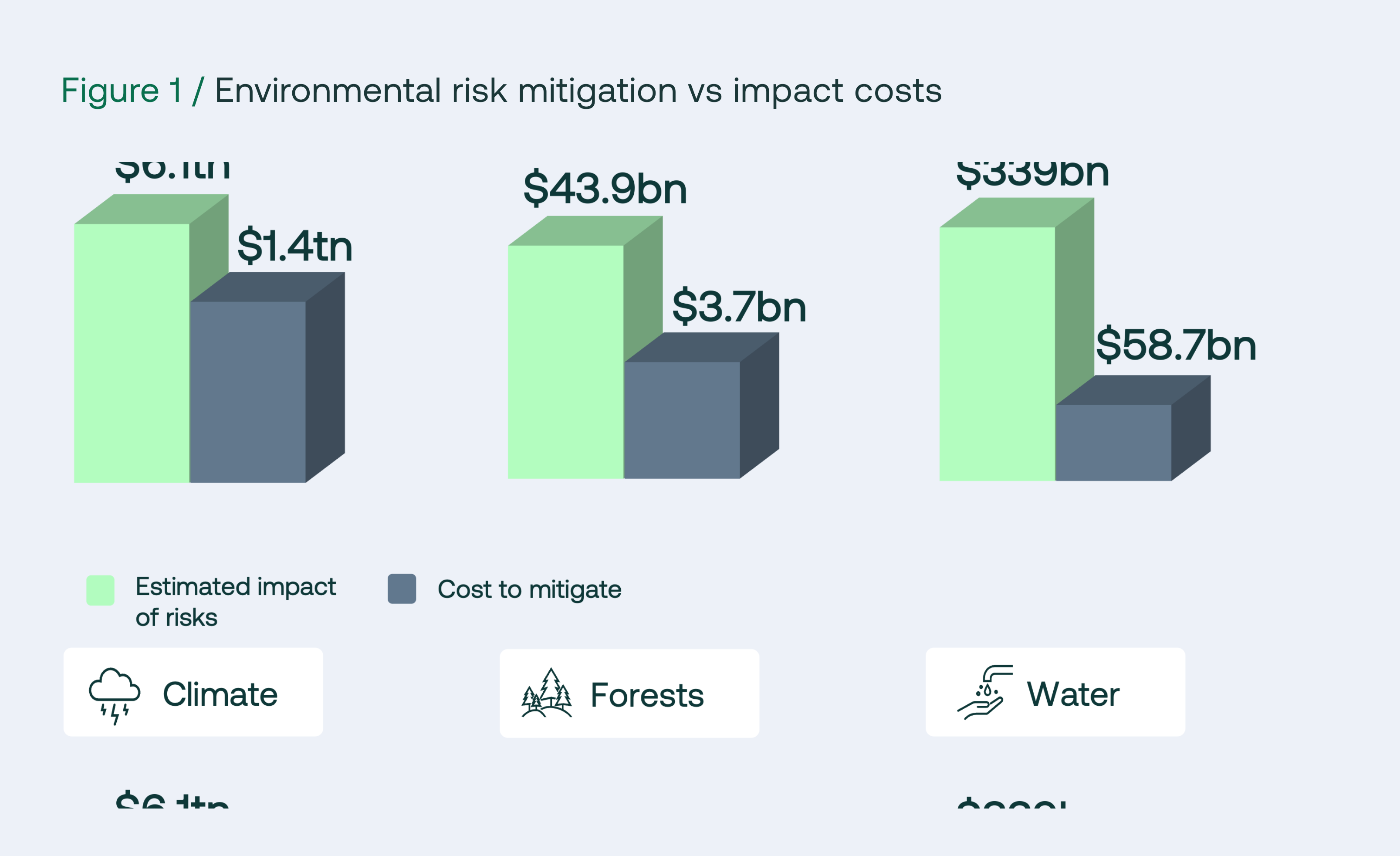
This is why the CDP framework continues to gain momentum. In 2025, over 22,000 companies responded to CDP disclosure requests, representing nearly two-thirds of global market capitalisation. Perhaps most telling: 4,400 companies disclosed for the first time, signalling that the benefits of CDP as a platform for climate reporting continue to grow.
Source: CDP
The CDP reporting cycle follows a predictable schedule, and knowing these key dates helps you plan effectively:
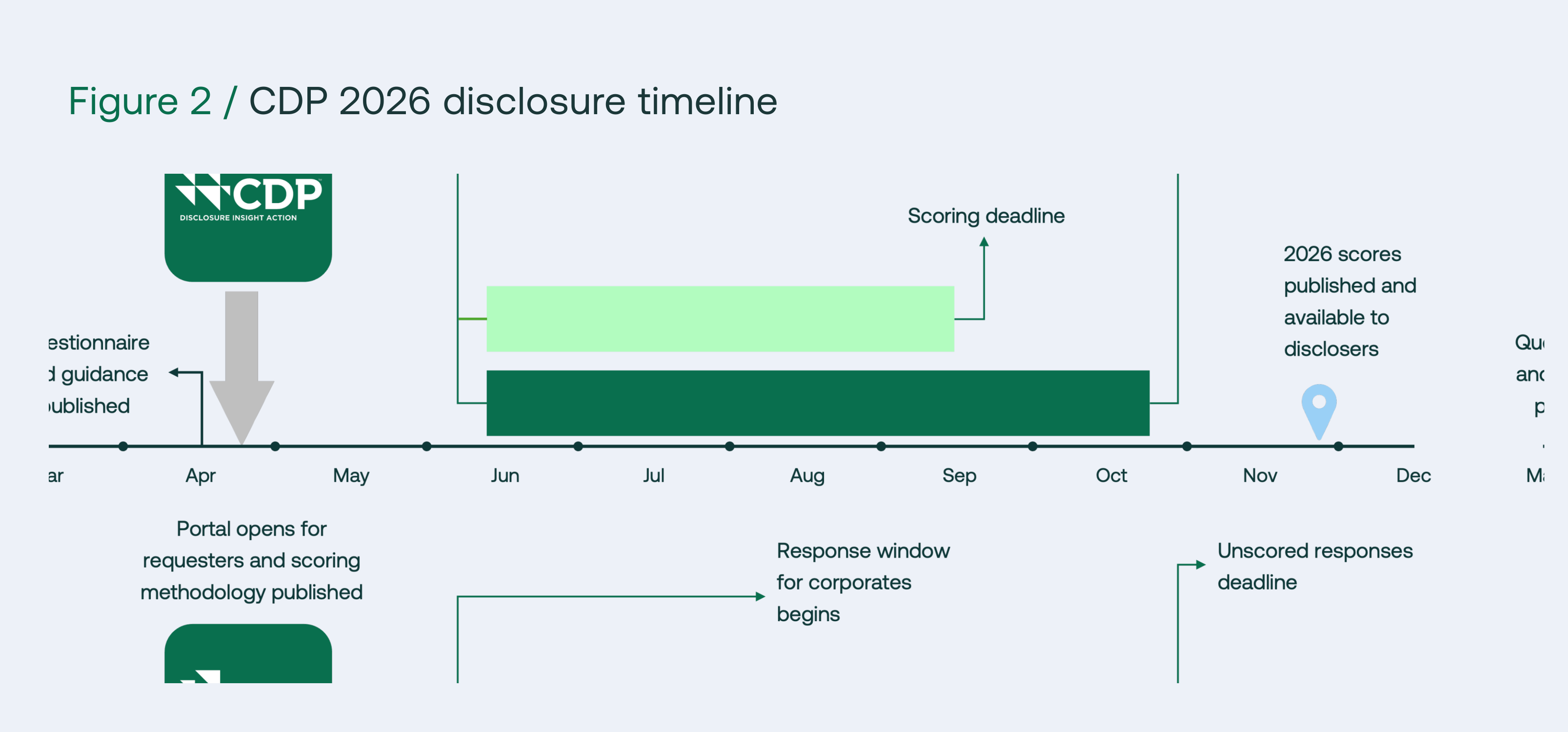
Critical advice: Submit at least one week before the 14 September deadline. Every year, platform strain on the final day causes crashes. Companies relying on last-minute submissions risk technical issues affecting their ability to submit on time.
The 2026 CDP questionnaire brings six notable updates designed to strengthen environmental disclosure and broaden the scope of reporting. These changes reflect CDP’s commitment to comprehensive environmental impact disclosure whilst maintaining alignment with evolving global standards.
The introduction of ocean disclosure represents the most visible change to the 2026 CDP reporting framework. This responds to increased market demand for reporting on ocean-related data, with financial institutions like BNP Paribas publicly encouraging companies to make this information available.
The ocean module will be:
Whilst the full question bank isn’t yet released, expect questions on key dependencies and impacts on marine ecosystems, priority locations in your value chain vulnerable to ocean-related risks, and targets for reducing environmental pressures on oceans. Companies with material ocean-related dependencies, impacts, risks and opportunities – such as seafood, shipping, coastal tourism, marine renewable energy etc. – are particularly encouraged to opt in.
For climate disclosure, the good news is stability. No major changes affect the climate questionnaire in 2026. Companies can expect similar questions to 2025, with minor phrasing updates for clarity.
Forests security reporting sees significant expansion:
Water security reporting introduces more stringent requirements. CDP now accepts Science Based Targets for Nature for freshwater quantity and quality, alongside more detailed questions on wastewater treatment levels before discharge. Additional detail is required on pollutant measurement success, and companies must explain if they’re not currently measuring discharge pollutants.
The plastics module remains unscored but adds new questions on plastics-related targets, metrics on packaging formats used across product portfolios, data on packaging designed for recycling and composting, and volume of products sold through reuse models.
Small and medium enterprises receive welcome news: they’re now eligible for A-level scores. Previously capped at B, this change recognises that environmental leadership isn’t determined by company size. SMEs with robust environmental management can now achieve the same recognition as larger corporations.
CDP expands existing questions on how organisations prepare for environmental risks. This update gives companies options to disclose adaptation measures throughout their operations in greater detail, with adjusted scoring to incentivise and reward comprehensive adaptation strategies.
Interested in diving deeper into the changes and what they mean at this stage? Watch the session on demand!

One of the most significant ongoing developments is CDP’s strengthening alignment with major standards and frameworks. This interoperability reduces reporting burden by allowing companies to prepare data once and use it across multiple climate reporting requirements.
Current alignment levels:
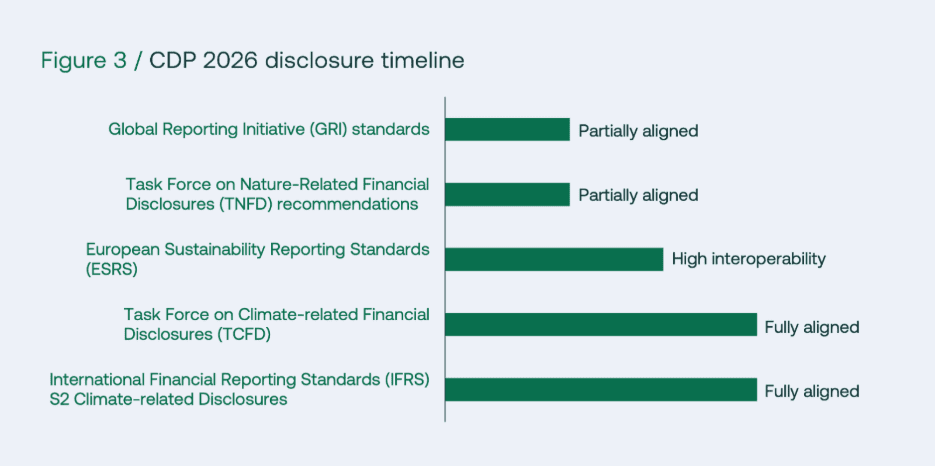
For CSRD-obligated companies, this alignment is particularly valuable. Your CDP disclosure supports ESRS E1 compliance across climate risks, GHG emissions, transition plans, economic activities and governance – reversely, ESRS E1 compliance means much of CDP-requested content is readily available
CDP’s scoring methodology remains highly complex, and predicting scores is difficult because score thresholds can change year-on-year, redistributing companies between scoring bands based on overall performance. The essential criteria present the biggest challenge. Despite strong performance across governance, strategies or reporting, reaching A level remains difficult without meeting specific criteria, for example for Climate (non-exhaustive)
Missing even one essential A-list criterion caps your score at A-, misisng even one Leadership criterion caps your score at B and so on, regardless of how well you perform elsewhere.
Science Based Targets Initiative validation covers the target component, but a complete transition plan requires substantially more. CDP’s guidance defines a 1.5-degree transition plan as including validated targets with science-based emissions reduction targets aligned with 1.5°C, but that’s just the starting point.
You’ll also need a detailed action plan specifying measures to address emissions across scopes, financial mapping showing investment requirements tied to specific actions, and governance integration demonstrating upper management involvement and responsibility. Most importantly, the plan must show strategic embedding with evidence that climate action is core to business strategy, not merely aspirational. The plan must demonstrate that climate action is genuinely integrated into your operations and decision-making.
Don’t underestimate the reporting burden. CDP largely remains an ad hoc exercise requiring significant data collection efforts and resources. Companies often have elements in place to address CDP questions but not to the level of detail requested. Starting early is essential:
This preparation helps identify gaps between what you have and what CDP expects.
Yes, both water security reporting and forests security reporting receive scores, just like climate. However, you may not be required to respond to these modules. Three scenarios exist:
Currently, only plastics and biodiversity (and Ocean starting this year) modules remain unscored, though this could change in future cycles as these frameworks mature.
Submitting a public response is mandatory at the Leadership level (A-). Companies that do not make their response public will be capped at a B score. Therefore, publishing a public response is required not only to achieve an A (A-List) score, but also to attain an A- level.
Although companies aren’t expected to report quantitative data aligned with the GHG Protocol’s new Land Sector and Removals Standard in 2026, CDP will integrate it from 2027 onwards. If this guidance is relevant to your operations – particularly if you have agricultural activities or land-related emissions – start adopting it now. The first year implementing new guidance always presents friction. Starting early gives you time to refine your processes.
CDP shouldn’t exist as an isolated exercise. Create internal alignment across disclosures:
This strategic approach transforms CDP from an annual burden into part of an integrated environmental impact disclosure strategy.
Whether you need full support or targeted guidance, we offer solutions across the disclosure journey.
Strong CDP support requires robust underlying data. We also help you with:
At Nexio Projects, we support clients across more than 20 countries in over 25 sectors, including shipping and logistics, manufacturing, chemicals, consumer goods, packaging, and more.
With 50+ experts from 25 nationalities spread across four continents and speaking over 10 languages, we’ve guided 400+ clients across 1,000+ projects on their sustainability journeys. Our integrated approach covers ratings and certifications such as EcoVadis and B Corp, climate change, ESG strategy, and CSRD and reporting compliance.
We bring clarity from climate impacts to supply chain challenges. Our team helps you navigate the complex landscape of environmental disclosure, turning reporting obligations into strategic opportunities.
Ready to prepare for CDP 2026? Book a free consultation with our climate experts. We’ll discuss your specific situation and identify how our CDP support can help you navigate the upcoming disclosure season successfully.
If you’re interested to see more climate updates, trends and best practices, sign up to our newsletter.
This article dives deep into the Essential Criteria for CDP submissions, gap analysis, sector-specific tailoring, third-party verification requirements, and board oversight. It provides actionable steps to avoid surprises and achieve leadership-level scores.
Comprehensive overview of the 2025 CDP questionnaire changes, minor but meaningful adjustments, timelines, and practical tips to ensure your reporting remains credible and future-ready.
Covers key steps to embed climate risk assessment and monitoring into your ESG strategy aligned with CDP expectations and broader regulatory demands.
Insights on leveraging CDP to demonstrate your commitment to sustainable business and to align disclosures with evolving stakeholder expectations.
Held on 11 February 2025, this webinar covers CDP criteria essentials, common pitfalls, major updates impacting scoring, and practical strategies for newcomers and experienced reporters. A Q&A segment covers topics such as taxonomy disclosures, data collection software, and CDP-SBTi alignment.
Explores the 2025 streamlined questionnaire format and best practices to navigate it efficiently, including verification, scoring methodology, and software solution recommendations.
Focuses on how to engage internal and external stakeholders effectively during your decarbonisation journey, supporting your CDP climate risk and opportunity disclosures.
Upcoming on 9 October 2025, this webinar will equip you to manage climate risks within the framework of CDP, TCFD, ISSB, and CSRD, critical for comprehensive climate reporting.