 UK SRS: Are you next in scope?
March 25, 2026

B Corp certification has always demanded more than good intentions. The 2025 overhaul of the B Corp standards marks a step change in what that commitment actually requires.
For companies currently certified, or working towards certification for the first time, the question is the same: what exactly changed, and what does it mean in practice? This article provides a clear comparison and a practical guide to what comes next.
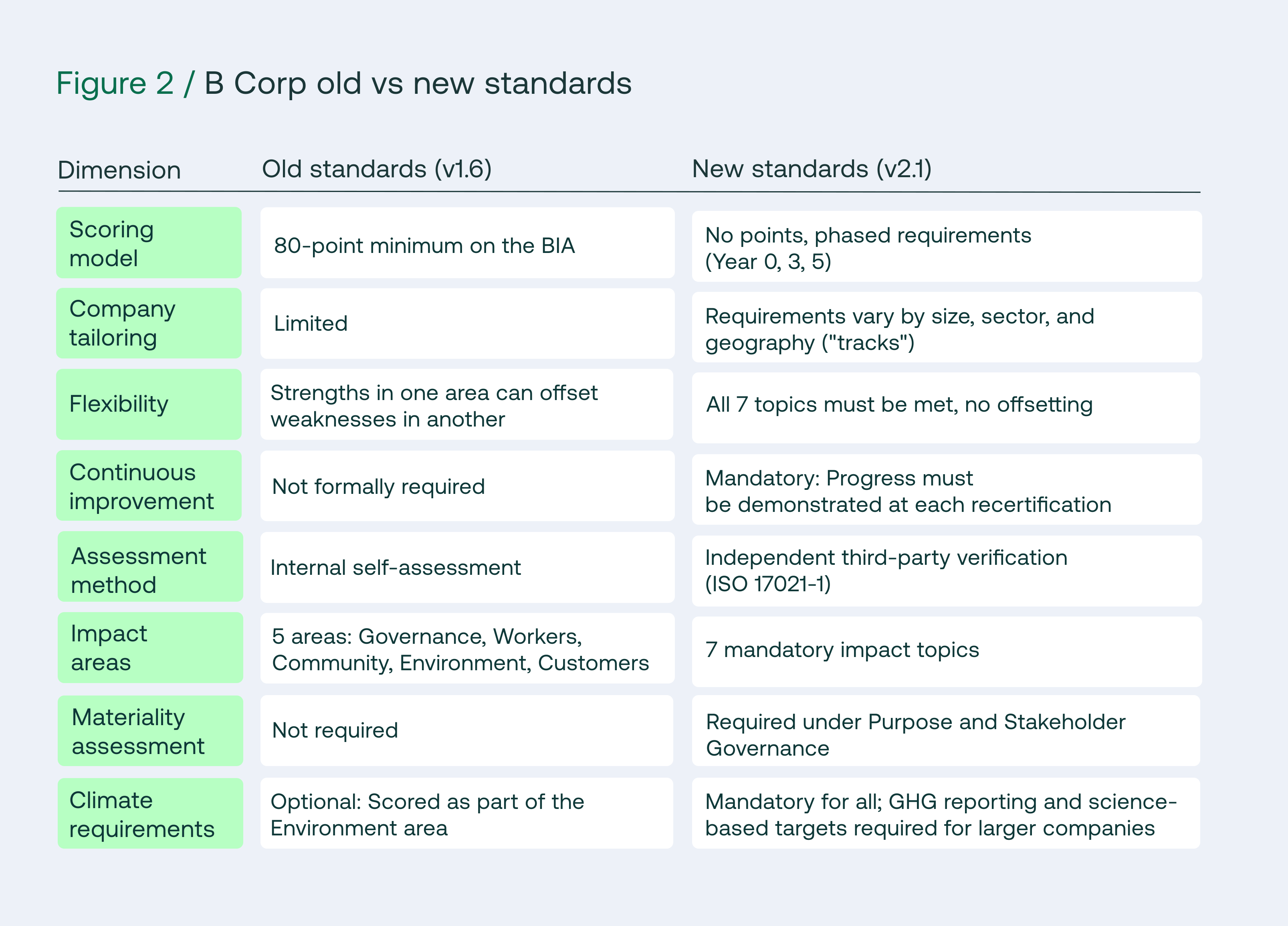
To achieve certification, a company needed to score at least 80 points across five impact areas [1]:
The BIA was a self-assessment. Companies gathered data, answered the questionnaire, and submitted supporting documentation. The 80-point threshold applied to the overall score, not to any individual area. A company could perform poorly on Environment and still achieve certification by excelling on Workers and Community.
That flexibility was both the system’s strength and its weakness. It allowed businesses with very different models to demonstrate impact. It also created real loopholes — and a growing credibility problem.
On 8 April 2025, B Lab launched a comprehensive revision of the B Corp standards — referred to as Version 2.1 [1]. The scoring model is gone, and all requirements now need to be met to certify. In its place is a requirements-based framework built around two components.
Part 1: Foundation Requirements. Companies must first pass eligibility checks confirming that certification is appropriate for their business type, size, and sector.
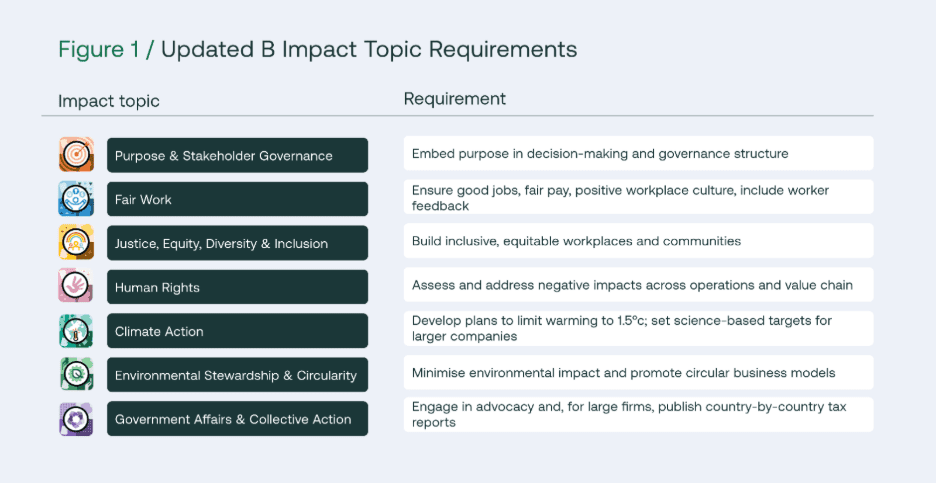
Part 2: Seven mandatory impact topics. Companies must then meet requirements across all seven of the following areas [2]:
Important to know: The scoring model is gone, and all requirements now need to be met to certify.
Each impact topic carries phased requirements. Companies must meet Year 0 requirements to achieve initial certification. Additional requirements apply at Year 3 and Year 5 of the certification cycle. Meeting minimum requirements is not enough over the long term, companies must demonstrate measurable improvement.
All assessments are now conducted by independent third parties under ISO 17021-1 requirements [2], replacing the self-assessment model used previously.
Your path forward depends on when you are due to recertify and your company size [3]:
Companies that are unable to commit to recertifying by 27 September 2026 may instead sign an amendment to their B Corp agreement that includes a waiver. This waiver enables them to maintain their certification under the current v1.6 standards on an interim basis, while formally committing to recertify against v2.1 at their next scheduled recertification date.[3]
However, it is important to note what the waiver entails. By signing, a company is effectively acknowledging that it does not yet meet (or cannot yet commit to meeting) the updated requirements within the current timeline, but wishes to retain the B Corp designation temporarily. In doing so, it accepts the associated legal and reputational risks of continuing to use the certification during this transition period, and agrees to limit B Lab’s liability (including waiving certain claims) in connection with those risks. The amendment also typically confirms the company’s obligation to comply with any updated rules governing the use of the B Corp logo and related brand assets, and reiterates the commitment to transition to the new v2.1 standards at the next recertification milestone.[3]
New applicants must certify under the new standards from January 2026. There is no option to certify under the old framework.
The practical steps are largely the same whether you are an existing B Corp or a new applicant. The difference is urgency.
For companies already navigating CSRD obligations, several of the new B Corp requirements overlap directly with what you are likely building anyway: a double materiality assessment, climate action planning, human rights due diligence, and transparent stakeholder governance.
The parallels run deep. The impact materiality assessment now required under B Corp’s Purpose and Stakeholder Governance topic mirrors the double materiality assessment central to CSRD. The climate action requirements — GHG reporting and science-based targets — align closely with ESRS E1. Human rights due diligence, required under B Corp’s Human Rights topic, is similarly embedded in ESRS S2. B Lab has deliberately built interoperability with ESRS, GRI, and CDP into v2.1, meaning data collected for CSRD reporting can contribute directly to your B Corp assessment [4].
That alignment is an opportunity. Rather than treating B Corp recertification as a separate workstream, companies can integrate its requirements into their broader sustainability strategy and reporting infrastructure. The governance structures, data systems, and evidence bases built for CSRD assurance will go a long way towards satisfying the new B Corp verification requirements. Done well, the two frameworks reinforce each other rather than compete for time and resources.
The old B Corp standards rewarded sustainability performance as companies chose to define it. The new standards set the terms. Seven non-negotiable topics, phased requirements, third-party verification, and a mandatory improvement trajectory change the nature of what certification means — and raises its credibility.
For companies already committed to their sustainability journey, the new framework is a natural extension of what they are already doing. For those who treated certification as a one-off box-ticking exercise, 2026 is the year that model runs out. The transition window is open. The time to act is now.
Assessing your company’s readiness for the new B Corp standards is the essential first step. Nexio Projects is your one-stop sustainability consultancy, with expertise across ratings, reporting and climate. We have been B Corp certified and a B Way Partner since 2019, showing our dedication and strong partnership in the area. Our team of accredited B Leaders can guide you through a gap assessment, build your multi-year roadmap, and prepare your documentation for third-party verification.
Visit our B Corp certification service page
[1] B Lab (2025). B Lab publishes new B Corp standards, raising the bar for businesses worldwide. https://www.bcorporation.net/en-us/news/press/b-lab-publishes-new-b-corp-standards-raising-the-bar-for-businesses-worldwide/ Accessed March 2026.
[2] B Lab (2025). Explore the B Lab Standards. https://www.bcorporation.net/standards/performance-requirements/ Accessed March 2026.
[3] B Lab (2025). Guidance for all B Corps due to recertify in 2025/2026. https://kb.bimpactassessment.net/en/support/solutions/articles/43000753161-guidance-for-all-b-corps-due-to-recertify-in-2025-2026 Accessed March 2026.
[4] B Lab (2025). Frequently Asked Questions — Certifying on B Lab’s New Standards. https://kb.bimpactassessment.net/en/support/solutions/articles/43000753428-frequently-asked-questions-certifying-on-b-lab-s-new-standards Accessed March 2026.